

Understand what the speaking task actually demands
Build a Resso scenario that matches the task
A step-by-step practice workflow for Duolingo English Test speaking
Review feedback in the right order
A focused 30-minute practice session
Move from coaching toward official conditions
Prepare for Duolingo English Test speaking by practicing rapid idea selection, visual description, prompt response, interactive follow-ups, and representative samples.
High-stakes English tests compress several language skills into a short speaking window. You need to understand the task, retrieve useful language, organize meaning, and stay understandable while the clock and recording continue. For students preparing for speaking tasks on the Duolingo English Test, progress comes from repeated, specific practice rather than from collecting model answers.
Resso language practice can provide a private place to speak, receive follow-up questions, review feedback, and retry. This guide turns that capability into a workflow for duolingo english test speaking. It keeps official materials and qualified teachers in the loop because an independent practice tool cannot reproduce an official examiner, security process, or score.
Understand what the speaking task actually demands
The Duolingo English Test includes speaking tasks that can involve responding to written, visual, or spoken prompts, taking part in an interactive exchange, and producing a speaking sample. Exact task names and conditions can change, so current official readiness materials should guide the final practice plan.
The online environment creates a particular challenge: you must understand the prompt, select an idea quickly, speak to a microphone without conversational body language, and sustain a coherent response while following strict test-security rules.
Resso can help with rapid response, follow-up questions, and varied topics before the test. It should be used for legitimate skill practice, not during an official test session and not to reconstruct secured questions.
Before building a practice routine, open the current official test information and confirm the task names, timing, instructions, scoring information, and permitted materials. Save the date you checked it. This small step prevents an old video or forum post from shaping weeks of practice.
Build a Resso scenario that matches the task
Build four original prompt modes in Resso: describe an unbranded everyday image, read then speak, listen then speak, and an interactive sequence that adapts to the previous answer. Add a final extended sample on a fresh topic. Keep prompts general and never copy secured test material.
Use Resso's custom scenario builder to define the role, context, prompt sequence, and success criteria. Keep prompts original and representative. Do not copy secured questions, imply access to live test content, or let the practice partner explain an answer before you have attempted it.
Before the first response, complete these checks:
- Review current official DET task descriptions and rules
- Prepare in the same quiet, well-lit type of space without violating test-day policy
- Practice looking at the camera area without forcing eye contact
- Use fresh prompts and representative samples
A step-by-step practice workflow for Duolingo English Test speaking
The sequence below is specific to the communication demands of this task. Complete a clean baseline first. Then change one behavior at a time so you can tell which adjustment helped.
Step 1: Read or listen for the command
Identify whether the prompt asks you to describe, explain, compare, narrate, or argue. Answering the topic but missing the requested action creates an avoidable task problem.
Step 2: Select a simple route quickly
Choose two or three connected points and a closing idea. The route should be easy enough to hold without notes when the official task does not permit them.
Step 3: Describe visuals by hierarchy
Start with the overall scene, then describe the most informative people, objects, relationships, or actions. Avoid guessing sensitive identities or inventing a dramatic story unsupported by the image.
Step 4: Develop prompt responses
State the main response, give a reason, add a specific example, and explain its significance. Use the available time to deepen the idea rather than repeating the prompt.
Step 5: Stay responsive in interactive speaking
Listen to how each follow-up changes the focus. Refer back when useful, but answer the new question directly. Practice clarifying or qualifying instead of repeating the previous answer.
Step 6: Make the sample representative
Use a clear beginning, developed middle, and deliberate ending. Show natural language you can control. Do not fill the sample with memorized claims that an institution could not reasonably connect to the prompt.
Keep the final attempt on a new prompt. That transfer check matters because a response can sound better simply through familiarity. For a broader routine built around real conversation, see How Students Can Use Resso for Real Conversation Practice in a New Language.
Review feedback in the right order
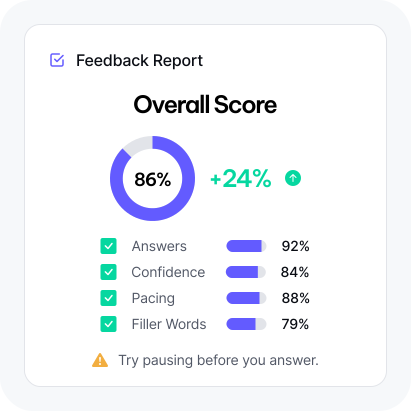
Review task fulfillment, idea development, coherence, vocabulary, grammar, pronunciation, and recording clarity. For visual tasks, check whether the description is grounded. For interactive tasks, check whether each answer responds to the new turn. For samples, check whether the response represents your current ability rather than a rehearsed artifact.
Use Resso feedback to locate a moment, not to replace your whole answer. Write a compact note in this form: evidence, likely cause, next action, transfer prompt. If the suggestion depends on an uncertain transcript, scoring interpretation, or pronunciation judgment, listen again and ask a qualified person. The related guide IELTS, TOEFL, PTE, CELPIP, or Duolingo: Choose and Practice for the Right Test can help you place this feedback inside the wider test strategy.
A focused 30-minute practice session
A short session works when every block has a purpose. Use this sequence as a starting point, then adjust for access needs, fatigue, and your teacher's guidance:
- Five minutes: identify the command in ten short prompts
- Eight minutes: describe two original everyday images
- Ten minutes: complete one read-or-listen prompt and an interactive follow-up chain
- Seven minutes: produce a fresh extended sample and review task fulfillment
Stop the review after selecting one next action. Endless replay encourages self-criticism without necessarily creating better speech. On another day, use How to Use Resso Feedback Without Memorizing IELTS Scripts to work on a connected weakness without repeating the same prompt.
Common mistakes to avoid
These habits can make practice feel productive while reducing its value:
- Practicing from recalled secured questions
- Ignoring the command word in the prompt
- Inventing unsupported details in an image
- Repeating one response during interactive follow-ups
- Using outside help during the official test
The correction is not to remove personality or speak like a model recording. Keep your own experiences, accent, and reasonable speaking style. Improve whether the listener can follow the meaning and whether the response performs the requested task.
Move from coaching toward official conditions
Early practice can use captions, visible planning cues, replay, and generous preparation. Reduce those supports gradually when the official task does not provide them. Use fresh prompts, the expected recording setup, and realistic interruption rules. Maintain approved accessibility arrangements and follow the provider's current accommodation process.
Resso remains most valuable as the repetition layer around official materials and human coaching. A teacher can interpret recurring language patterns, a test provider defines the format, and an authorized test produces the result. The Duolingo English Test is provided by Duolingo. Resso is not affiliated with or endorsed by Duolingo. Follow current official task information, equipment rules, identity checks, and test-security requirements.
Track progress without predicting an official score
Track time to a relevant first sentence, number of connected supporting points, completion, grounded visual details, and direct response to follow-ups. Use varied original prompts. Familiarity with one image or topic should never be mistaken for broad speaking readiness.
Compare like with like: similar task family, fresh prompt, similar preparation time, and similar equipment. Keep confidence, language performance, and technical quality in separate columns. If you want a deeper plan for applying feedback across a week, use How to Practice for TOEFL iBT Speaking With Resso.
Frequently asked questions
Can I use Resso during the official online test?
No. Follow official DET rules and use no unauthorized assistance. Resso is for preparation before the test.
Should I memorize a speaking sample?
No. Practice organizing extended responses on many topics so the submitted sample reflects your actual ability and the prompt you receive.
How do I practice interactive speaking?
Use follow-up chains where each question depends on your previous answer. Train yourself to notice the new focus and respond directly.
Practice the task, then transfer the skill
Effective test preparation develops language you can use when the wording, topic, or follow-up changes. Match the practice design to Duolingo English Test speaking, complete the response before over-editing it, review evidence in a sensible order, and test every improvement on unfamiliar material.
With Resso for Education, learners and educators can build repeatable speaking scenarios while keeping official rules and human judgment authoritative. Start with one baseline, choose one high-impact change, and build enough varied repetitions for that change to survive the next question. Talk with Resso about language-practice coaching.