

Understand what the speaking task actually demands
Build a Resso scenario that matches the task
A step-by-step practice workflow for TOEFL iBT Speaking
Review feedback in the right order
A focused 30-minute practice session
Move from coaching toward official conditions
Prepare for the current TOEFL iBT Speaking task types with focused listening, accurate repetition, concise interview responses, and microphone-ready practice.
High-stakes English tests compress several language skills into a short speaking window. You need to understand the task, retrieve useful language, organize meaning, and stay understandable while the clock and recording continue. For students preparing for the current TOEFL iBT Speaking section, progress comes from repeated, specific practice rather than from collecting model answers.
Resso language practice can provide a private place to speak, receive follow-up questions, review feedback, and retry. This guide turns that capability into a workflow for toefl ibt speaking. It keeps official materials and qualified teachers in the loop because an independent practice tool cannot reproduce an official examiner, security process, or score.
Understand what the speaking task actually demands
The current TOEFL iBT Speaking section uses focused task types called Listen and Repeat and Take an Interview. The first requires accurate, intelligible reproduction of short spoken sentences. The second uses simulated interview questions related to academic or campus situations.
That design rewards two different kinds of control. Listen and Repeat requires attention to wording, sound sequence, stress, and rhythm without adding or dropping meaning. Take an Interview requires relevant ideas, clear organization, natural pace, and usable vocabulary and grammar.
Many older preparation resources describe a previous TOEFL speaking format. Build your plan from the current official ETS page and practice materials. Resso can provide responsive coaching around the skills, but it must not be used to invent or predict official test content.
Before building a practice routine, open the current official test information and confirm the task names, timing, instructions, scoring information, and permitted materials. Save the date you checked it. This small step prevents an old video or forum post from shaping weeks of practice.
Build a Resso scenario that matches the task
Create two separate Resso modes. In accuracy mode, present one short campus or academic sentence orally, allow one listen, and ask for an exact spoken repetition before review. In interview mode, ask concise experience and opinion questions one at a time, then add a natural follow-up. Keep the device, headset, and recording position consistent.
Use Resso's custom scenario builder to define the role, context, prompt sequence, and success criteria. Keep prompts original and representative. Do not copy secured questions, imply access to live test content, or let the practice partner explain an answer before you have attempted it.
Before the first response, complete these checks:
- Confirm the current official TOEFL speaking format
- Use an external microphone only if it resembles your normal test practice setup
- Separate repetition accuracy from interview development
- Record a baseline in both task families
A step-by-step practice workflow for TOEFL iBT Speaking
The sequence below is specific to the communication demands of this task. Complete a clean baseline first. Then change one behavior at a time so you can tell which adjustment helped.
Step 1: Listen for the sentence skeleton
Catch the subject, main verb, object or complement, and key modifiers. Meaning provides a memory frame. Do not focus so hard on one unfamiliar word that you lose the rest of the sentence.
Step 2: Hold the rhythm and word groups
Repeat meaningful chunks with the original stress pattern and connections. Accurate sequence matters, but intelligible rhythm can help preserve the sentence as a whole.
Step 3: Audit additions and omissions
Compare what you said with the source. Mark dropped grammar words, changed endings, reordered phrases, and substituted content words. Drill the error type on new sentences instead of memorizing the original.
Step 4: Answer interview questions directly
Give your response in the first sentence, then add a reason and a concrete academic or campus example. Use a natural pace and complete the idea within the current official response conditions.
Step 5: Adapt to a follow-up
Let Resso ask for clarification, comparison, or consequence. Maintain the position or explain a reasonable change. This builds responsive speaking rather than a bank of canned opinions.
Step 6: Practice the microphone routine
Speak at a consistent distance and volume, begin promptly, and continue after a minor stumble. Review whether equipment or room noise affected the evidence before diagnosing language.
Keep the final attempt on a new prompt. That transfer check matters because a response can sound better simply through familiarity. For a broader routine built around real conversation, see How Students Can Use Resso for Real Conversation Practice in a New Language.
Review feedback in the right order
Use separate evidence for each task family. For repetition, track exact sequence, omissions, additions, intelligibility, and rhythm. For interview responses, track relevance, development, clarity, pace, vocabulary, and grammar. Do not average them into a homemade score or compare the result with obsolete task rubrics.
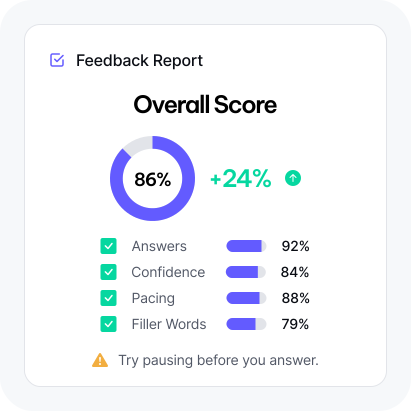
Use Resso feedback to locate a moment, not to replace your whole answer. Write a compact note in this form: evidence, likely cause, next action, transfer prompt. If the suggestion depends on an uncertain transcript, scoring interpretation, or pronunciation judgment, listen again and ask a qualified person. The related guide IELTS, TOEFL, PTE, CELPIP, or Duolingo: Choose and Practice for the Right Test can help you place this feedback inside the wider test strategy.
A focused 30-minute practice session
A short session works when every block has a purpose. Use this sequence as a starting point, then adjust for access needs, fatigue, and your teacher's guidance:
- Six minutes: repeat short sentences in meaningful chunks
- Six minutes: diagnose one recurring omission or sound pattern
- Ten minutes: answer current-style interview questions and follow-ups
- Eight minutes: repeat both task types with fresh material under consistent recording conditions
Stop the review after selecting one next action. Endless replay encourages self-criticism without necessarily creating better speech. On another day, use IELTS Speaking Fluency: Improve Pacing, Pauses, and Repair to work on a connected weakness without repeating the same prompt.
Common mistakes to avoid
These habits can make practice feel productive while reducing its value:
- Preparing with the pre-2026 task format
- Memorizing a sentence after several listens instead of practicing one-listen processing
- Adding synonyms during exact repetition
- Giving an interview speech before answering the question
- Mistaking microphone noise for a language problem
The correction is not to remove personality or speak like a model recording. Keep your own experiences, accent, and reasonable speaking style. Improve whether the listener can follow the meaning and whether the response performs the requested task.
Move from coaching toward official conditions
Early practice can use captions, visible planning cues, replay, and generous preparation. Reduce those supports gradually when the official task does not provide them. Use fresh prompts, the expected recording setup, and realistic interruption rules. Maintain approved accessibility arrangements and follow the provider's current accommodation process.
Resso remains most valuable as the repetition layer around official materials and human coaching. A teacher can interpret recurring language patterns, a test provider defines the format, and an authorized test produces the result. TOEFL and TOEFL iBT are ETS trademarks. Resso is not affiliated with or endorsed by ETS. Confirm task types, timing, scoring, and test-day rules through current official ETS materials.
Track progress without predicting an official score
Maintain two logs. In repetition, record the proportion of sentences reproduced without meaning-changing omissions or substitutions. In interview practice, record direct answers, developed reasons, completed examples, and recovery. Use new official-style samples often enough to prevent familiarity from inflating performance.
Compare like with like: similar task family, fresh prompt, similar preparation time, and similar equipment. Keep confidence, language performance, and technical quality in separate columns. If you want a deeper plan for applying feedback across a week, use IELTS Pronunciation Practice: Focus on Intelligibility, Stress, and Rhythm.
Frequently asked questions
Why do some TOEFL speaking guides show different tasks?
The TOEFL iBT format changed. Use the current official ETS Speaking page and date-check third-party resources before practicing.
Should I change words in Listen and Repeat?
The task asks you to repeat the sentence as heard. Practice accurate reproduction rather than paraphrase for that task.
Can Resso give an official TOEFL score?
No. Use it for targeted speaking practice and review. Official scores come only through the authorized TOEFL testing process.
Practice the task, then transfer the skill
Effective test preparation develops language you can use when the wording, topic, or follow-up changes. Match the practice design to TOEFL iBT Speaking, complete the response before over-editing it, review evidence in a sensible order, and test every improvement on unfamiliar material.
With Resso for Education, learners and educators can build repeatable speaking scenarios while keeping official rules and human judgment authoritative. Start with one baseline, choose one high-impact change, and build enough varied repetitions for that change to survive the next question. Talk with Resso about language-practice coaching.
.jpeg)
.jpeg)