

Why explaining an assignment aloud improves the final work
Prepare the Resso scenario from the prompt and rubric
Begin with a two-minute explanation of the whole assignment
Test the connection between claims, evidence, and method
Practice difficult questions without becoming defensive
Turn Resso feedback into a targeted revision list
Protect your authorship and academic integrity
Use Resso to test an assignment by building a scenario from the prompt and rubric, explaining the work aloud, answering probing questions, and revising the assignment where your reasoning becomes vague. The benefit is diagnostic: speaking can reveal missing assumptions, weak evidence, and confusing structure that remain hidden during silent rereading.
This method works for essays, lab reports, business cases, design projects, research proposals, technical work, and oral defences. Resso does not replace your sources, instructor, or academic judgment. Its education practice environment gives you a listener who can ask, “Why?”, “What supports that?”, and “What would change your conclusion?” before the deadline.
Why explaining an assignment aloud improves the final work
Writing lets you stop, search, edit, and reread. A live explanation asks you to retrieve the central idea and make the relationship between parts visible. If you cannot state what the assignment argues, demonstrates, or solves in plain language, the written version may also be carrying unnecessary complexity.
Resso's Assignment practice experience can question your reasoning against the criteria you provide. That is useful for checking comprehension and preparing for viva-style questions, presentations, project reviews, or an instructor conversation about your work.
The point is not to generate the assignment. It is to make your own understanding answerable. You should be able to identify where every claim, number, design choice, or interpretation came from and revise it when the spoken explanation reveals a gap.
Prepare the Resso scenario from the prompt and rubric
Add the assignment purpose, audience, required components, learning outcomes, and rubric criteria. State the discipline and level so questions match what the course expects. If one criterion matters most, such as evidence, methodology, feasibility, or ethical analysis, name it explicitly.
Include a short description of your current thesis or solution and the sections you plan to submit. Ask the avatar to probe assumptions, request evidence, test alternatives, and identify terms that need definition. For technical work, ask for conceptual questions rather than calculations the system cannot reliably verify.
Follow academic integrity and privacy rules. Do not upload restricted assessments, another student's work, confidential placement material, unpublished data, or content your institution prohibits sharing. An instructor-approved rubric and your own summary may be sufficient.
Begin with a two-minute explanation of the whole assignment
Before defending details, explain the project in two minutes: the problem or question, your approach, the main evidence, the conclusion, and one limitation. This forces prioritization. If the answer becomes a table of contents, ask what the listener actually needs to understand.
Review where you hesitated. A pause around the thesis may mean the argument is still broad. Difficulty describing the method may signal a missing rationale. An unclear conclusion may mean the evidence and claim are not aligned. Write these as revision questions rather than personal failures.
Repeat the explanation after making one structural change. The broader article on why speaking practice strengthens usable knowledge explains how retrieval and audience awareness can reveal understanding that written completion alone does not show.

Test the connection between claims, evidence, and method
Ask the Resso avatar to choose one central claim and keep asking what supports it. Name the evidence, explain why it is relevant, and distinguish what the evidence shows from what you infer. If you used sources, be ready to describe their role and limits without inventing details you cannot verify.
For a lab or research project, explain why the method fits the question, what variables or constraints matter, and what the results do not establish. For a design or business project, explain the user need, trade-offs, assumptions, and how success would be evaluated.
When the practice exposes a gap, return to the assignment. Add evidence, narrow a claim, justify a choice, or acknowledge a limitation. Do not merely create a smoother spoken defence of weak work. Communication practice should improve the reasoning underneath it.
Practice difficult questions without becoming defensive
A challenging question is not always an accusation. It may be a request for the missing bridge in your explanation. Practice acknowledging the concern, answering directly, showing the evidence, and naming uncertainty. If the criticism is valid, explain how you would revise the work.
Ask for alternative interpretations or approaches. You do not have to abandon your conclusion simply because another option exists, but you should be able to compare it fairly. Strong academic communication shows why a choice was reasonable under the available evidence and constraints.
Use conversation tone controls progressively if available: begin with a supportive examiner, then try a more probing one. The objective is not to tolerate hostility. It is to stay clear when a legitimate question arrives with less reassurance.
Turn Resso feedback into a targeted revision list
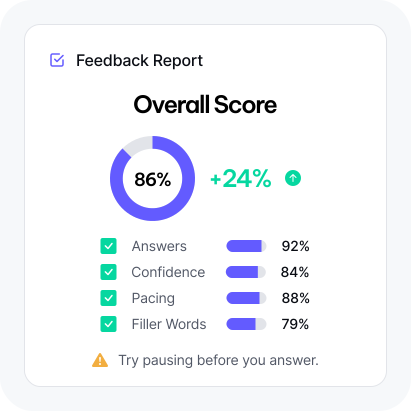
Separate content feedback from delivery feedback. Content priorities include a missing claim, unsupported assumption, undefined term, confusing sequence, or incomplete limitation. Delivery priorities include pace, answer length, signposting, and whether you addressed the question before adding detail.
Choose no more than three assignment revisions from one session. Make them concrete: move the thesis earlier, add a source for a specific claim, explain why the sample limits generalization, or connect the recommendation to the stated criteria. Then update the document and run the relevant explanation again.
If automated feedback conflicts with the rubric or disciplinary conventions, the course requirements win. Bring unresolved questions to office hours. A useful outcome of Resso practice can be knowing exactly what to ask your instructor.
Protect your authorship and academic integrity
Keep the argument, examples, analysis, and final wording yours. If your course allows AI-assisted preparation, document or disclose use in the way the instructor requires. Do not present generated citations, data, experiences, or interpretations as verified work.
Use Resso primarily as a practice listener: explain, answer, reflect, and revise. Check every factual suggestion against course materials and reliable sources. The tool's fluency does not prove that a claim is accurate or appropriate for your discipline.
If the assessment is closed, individual, or designed to test unaided performance, ask before using any AI system. Clear boundaries protect both your learning and the credibility of the final submission.
A three-pass Resso workflow before submission
Pass 1 — comprehension: explain the whole assignment in two minutes and identify unclear ideas.
Pass 2 — defence: answer questions about evidence, method, alternatives, and limitations. Revise the actual work after each pass.
Pass 3 — audience: explain the final version at the level the assignment requires and practice concise answers to likely questions. Finish by checking the official instructions, citations, formatting, submission requirements, and file itself outside Resso.
Leave enough time between passes to think. The benefit comes from revision between attempts, not from repeating the same explanation until it sounds familiar.
Frequently asked questions
Can I upload my rubric to Resso?
Use it only if your instructor and institutional policies allow. You can also summarize the criteria without uploading a restricted document.
Will Resso tell me whether my assignment is factually correct?
Treat Resso as a communication and reasoning practice partner. Verify facts, citations, calculations, and disciplinary requirements with authoritative course sources.
Is using Resso academic misconduct?
Policies differ by course and institution. Follow the rules for the specific assessment, ask when uncertain, and disclose AI-assisted work when required.
What should I do if I cannot answer a question?
Record the question, return to your sources or instructor, and revise the work. The gap is valuable information before submission.
Does this method work for group assignments?
Yes, if the team agrees and course rules permit it. Each member can explain their contribution and the group can practice shared decisions and handoffs.
Use spoken questions to make the written work stronger
Explaining an assignment aloud forces your reasoning to become visible. Resso can help you find where the thesis, evidence, method, or conclusion stops making sense to a listener and give you another attempt after revision.
Keep the tool in the right role. Your course defines the standards, your sources establish the facts, and your judgment owns the final work. Resso supplies a patient questioner before the deadline.