

Decide how much you want to share before the interview
Remove apology language and excessive justification
Show current readiness with recent evidence
Adjust the answer for layoffs, caregiving, health, travel, and study
Practice fair but uncomfortable follow-up questions
Explain a career gap with a short factual statement, only the context you want to share, evidence of current readiness, and a forward connection to the role. You do not owe an apology for caregiving, health, study, relocation, a layoff, or time used to reassess. You do need an answer that is clear enough to prevent the gap from becoming a mystery the interviewer fills with assumptions.
Most employers are not looking for a dramatic confession. They want to know that you can perform the work now, that your timeline is understandable, and that you are approaching the opportunity intentionally. The article on positioning experience during a career change can help align the written story. This guide focuses on saying it aloud.
Decide how much you want to share before the interview
Choose your privacy boundary in advance. You can say ‘I stepped away for a health matter that is now resolved’ without naming a diagnosis. You can say ‘I was caring for a family member’ without describing the person or circumstances. A boundary is easier to hold when the words have been practiced.
If the gap followed a layoff, state the business context without criticizing the former employer. If it followed burnout or a difficult workplace, focus on what you learned about the conditions in which you work well. The answer should be truthful, proportionate, and oriented toward the present.
Use a five-part bridge answer
A practical structure is: fact, brief context, useful activity, current readiness, and connection. For example, ‘My role was eliminated in a restructuring. I used the following months to complete a data visualization course and support a community project. I am now ready for a full-time role, and this position fits the analytical client work I want to continue.’
Not every gap includes formal upskilling, and you should not invent it. Useful activity may be caregiving, recovery, part-time work, volunteering, a job search, or simply regaining stability. The strongest proof of readiness can be recent preparation, clear availability, current knowledge, and a thoughtful reason for applying.
Remove apology language and excessive justification
Listen for phrases such as ‘unfortunately,’ ‘I know it looks bad,’ or ‘I hope that is not a problem.’ They teach the interviewer to treat the gap as evidence against you. Replace them with neutral transitions: ‘During that period,’ ‘After the role ended,’ or ‘When I was ready to return.’
Brevity is not evasiveness when the answer covers the relevant facts. If you speak for five minutes about a nine-month gap, the explanation can sound less settled than it is. Give enough context to make the timeline coherent, then move to evidence that relates to the current role.

Show current readiness with recent evidence
Employers often care less about the gap than about whether your skills and expectations are current. Prepare one recent example that demonstrates relevant knowledge. It might be a course project, freelance assignment, volunteer responsibility, industry event, portfolio update, or analysis of a problem in the employer's field.
Avoid turning a course list into proof by itself. Explain what you can now do, what you produced, or how your thinking changed. If your return requires a specific schedule or accommodation, decide when and how to discuss it based on the hiring process and local requirements.
Adjust the answer for layoffs, caregiving, health, travel, and study
A layoff answer should separate the business decision from your performance and quickly show momentum. A caregiving or health answer can protect personal details while confirming readiness. A travel or sabbatical answer should describe the decision responsibly and connect any learning only when it is genuine. A study gap should explain the capability gained.
For a long job search, avoid describing every rejection. State that you have been selective or that market conditions extended the search, then explain how you sharpened your target and maintained relevant activity. The guidance on job hunting in a slow market without losing confidence offers a broader plan for that period.
Practice fair but uncomfortable follow-up questions
Ask a practice interviewer to follow with questions such as ‘What changed that makes you ready now?’ ‘How have you kept your skills current?’ and ‘Why did the search take this long?’ Answer calmly, then redirect toward relevant evidence. The practice is useful because tone can become defensive even when the words are reasonable.
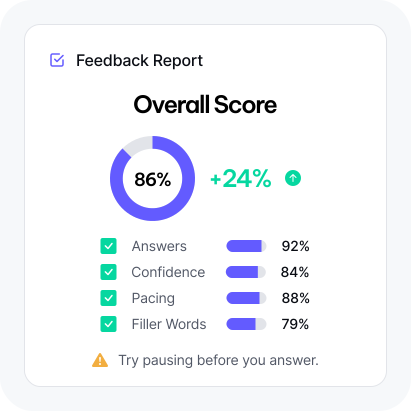
In Resso, give the AI interviewer the job level, your preferred privacy boundary, and the type of gap. Tell it not to request protected personal details, but to test readiness and relevance. Compare several attempts. The goal is not a higher score. It is a shorter, steadier answer that remains truthful when phrased in different ways.
Connect the gap to a credible next step
Finish by naming why this role is a sensible return or continuation. Refer to the work, the environment, or the capability you want to use. This forward connection prevents the answer from ending in the gap and gives the interviewer a productive place to continue.
Keep the connection specific. ‘I am excited about anything’ sounds like urgency, not fit. ‘I want to return to operations work where I can improve handoffs and support frontline teams’ gives the interviewer something meaningful to evaluate. It also creates a bridge to your Tell me about yourself answer.
Common mistakes to avoid
Career-gap answers become less credible when anxiety creates too much detail or when the candidate tries to prove that the time away had extraordinary value. A grounded answer avoids these traps.
Apologizing before explaining: An apology frames the gap as misconduct. Use neutral language and let the interviewer evaluate the relevant facts and present readiness.
Sharing more than you want: Pressure can make personal boundaries disappear. Choose in advance what you will say about health, family, legal, or financial circumstances and practice returning to job relevance.
Inventing productivity: A gap does not need a certificate, business, or heroic transformation to be legitimate. False activity creates risk and distracts from current evidence.
Blaming a former employer: Even when the experience was unfair, an interview is rarely the right place for a long argument. State the employment outcome and focus on what you seek next.
Promising perfect availability: Do not hide a real scheduling, accommodation, or start-date need just to end the question. Decide the appropriate time and explain the requirement clearly.
Letting the gap dominate: Answer the question, then return to capability. Your preparation should also cover achievements, work samples, and the role-specific evidence in the anatomy of a strong job application.
A seven-day practice plan
Day 1: Write the facts and decide which personal details remain private.
Day 2: Build the five-part bridge.
Day 3: collect one recent example that shows readiness.
Day 4: record a 45-second answer and remove apology language.
Day 5: Practice three fair follow-ups. Day 6: run a role-specific mock interview and notice where you become defensive or overexplain. Day 7: practice the final answer once in the morning and once later, then preserve the speaking beats rather than editing every word.
At the end of each day, keep three short notes: what felt easier, what evidence still needs work, and the exact next practice action. Do not grade the whole session from your mood immediately afterward. Compare the relevant answer or decision with the day's goal, preserve one strength, and make one change. This record turns preparation into a sequence of usable experiments instead of a search for one perfect performance.
Frequently asked questions
Do I need to explain a gap shorter than six months?
Not always. If asked, give a simple factual answer. Do not create a major story around a normal transition between roles.
Should I put the reason for the gap on my resume?
Only when it improves clarity and supports your story, such as full-time caregiving, study, or a planned sabbatical. A short gap may need no label.
What if the gap was related to mental health?
You can protect medical details. A statement that you stepped away for a health matter and are ready to return may be sufficient.
Can an employer ask follow-up questions?
They may ask about readiness and the timeline, but employment and privacy rules vary. You do not need to volunteer protected personal information.
What if I did not take courses during the gap?
Do not invent productivity. Focus on the real context, any current preparation, and evidence that you can perform the role now.
Make the gap one part of the timeline, not the whole story
A career gap becomes easier to discuss when you decide the boundary, state the facts, and move toward current evidence. A calm 30- to 60-second answer is often enough. Practice the follow-ups so a reasonable question does not push you into an apology.
Your time away may have been difficult, useful, necessary, or all three. The interview question is narrower: are you prepared for this work now, and can you explain why it is the right next step? Build the answer around that.

.jpeg)