

Understand what the speaking task actually demands
Build a Resso scenario that matches the task
A step-by-step practice workflow for IELTS Speaking preparation plan
Review feedback in the right order
A focused 30-minute practice session
Move from coaching toward official conditions
Follow a four-week IELTS Speaking plan that moves from baseline evidence to targeted drills, full simulations, and a calm final taper.
High-stakes English tests compress several language skills into a short speaking window. You need to understand the task, retrieve useful language, organize meaning, and stay understandable while the clock and recording continue. For IELTS candidates with four weeks available for structured speaking practice, progress comes from repeated, specific practice rather than from collecting model answers.
Resso language practice can provide a private place to speak, receive follow-up questions, review feedback, and retry. This guide turns that capability into a workflow for ielts speaking preparation plan. It keeps official materials and qualified teachers in the loop because an independent practice tool cannot reproduce an official examiner, security process, or score.
Understand what the speaking task actually demands
A useful four-week plan balances diagnosis, focused practice, varied retrieval, and realistic simulation. Doing a complete mock test every day can create fatigue while hiding the cause of recurring problems. Drilling isolated sounds or grammar without returning to full answers creates the opposite problem.
The plan below assumes regular short sessions, official sample materials, at least occasional qualified human feedback, and Resso for responsive repetition. It can be reduced or extended, but the order matters: establish a baseline before changing everything, then test improvements under new conditions.
Your target is not a perfect practice recording. It is a more reliable process for understanding questions, organizing an answer, retrieving language, staying intelligible, and recovering when the conversation changes.
Before building a practice routine, open the current official test information and confirm the task names, timing, instructions, scoring information, and permitted materials. Save the date you checked it. This small step prevents an old video or forum post from shaping weeks of practice.
Build a Resso scenario that matches the task
Create four Resso scenario sets: familiar interviews, long turns, abstract discussions, and mixed simulations. Tag prompts by topic and difficulty. Keep the scoring language descriptive, use the official public descriptors as a reference with a teacher, and never ask Resso to promise a band result.
Use Resso's custom scenario builder to define the role, context, prompt sequence, and success criteria. Keep prompts original and representative. Do not copy secured questions, imply access to live test content, or let the practice partner explain an answer before you have attempted it.
Before the first response, complete these checks:
- Schedule five short sessions and one longer review each week
- Record a full baseline before Week 1 drills
- Choose no more than two priority behaviors per week
- Reserve fresh official-style prompts for weekly checkpoints
A step-by-step practice workflow for IELTS Speaking preparation plan
The sequence below is specific to the communication demands of this task. Complete a clean baseline first. Then change one behavior at a time so you can tell which adjustment helped.
Step 1: Week 1: establish control
Map the format, record a baseline, and practice direct Part 1 answers plus simple long-turn planning. Identify one organization target and one delivery target. Keep topics familiar while the routine becomes automatic.
Step 2: Week 2: extend and connect
Work on long turns, reasons, examples, comparisons, and paraphrase. Repeat with new topics so structure remains flexible. Ask a teacher to review any recurring language or pronunciation issue with high impact.
Step 3: Week 3: add pressure and surprise
Mix parts, reduce preparation supports, and let follow-up questions vary. Practice one full simulation early in the week, diagnose the weakest behavior, then return to focused drills before another checkpoint.
Step 4: Week 4: consolidate, do not overhaul
Use two realistic simulations separated by recovery and targeted review. Keep useful routines stable. Avoid adding large vocabulary lists or rebuilding every answer style close to the test.
Step 5: Use an error budget
Choose the two patterns most likely to affect meaning or task completion. Accept minor slips while speaking and return to them during review. Constant self-correction can damage coherence more than an isolated error.
Step 6: Taper before test day
Finish the final demanding session early enough to rest. Use short warm-ups, familiar equipment, sleep, and current official test-day guidance. The last day is for readiness, not a marathon mock test.
Keep the final attempt on a new prompt. That transfer check matters because a response can sound better simply through familiarity. For a broader routine built around real conversation, see How Students Can Use Resso for Real Conversation Practice in a New Language.
Review feedback in the right order
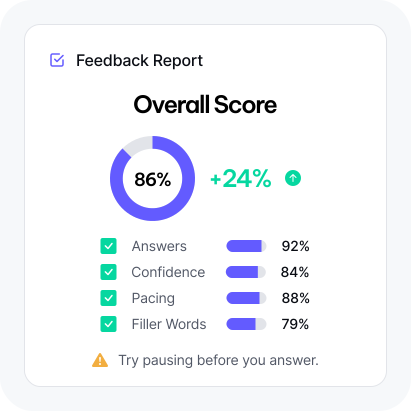
At the end of each week, compare a fresh sample with the baseline on the same behavior. Note evidence, not impressions: response latency, completed ideas, connected examples, successful repair, understandable key phrases, and ability to sustain the long turn. If a metric encourages unnatural speed or memorized wording, remove it.
Use Resso feedback to locate a moment, not to replace your whole answer. Write a compact note in this form: evidence, likely cause, next action, transfer prompt. If the suggestion depends on an uncertain transcript, scoring interpretation, or pronunciation judgment, listen again and ask a qualified person. The related guide How to Practice for IELTS Speaking With Resso can help you place this feedback inside the wider test strategy.
A focused 30-minute practice session
A short session works when every block has a purpose. Use this sequence as a starting point, then adjust for access needs, fatigue, and your teacher's guidance:
- Five minutes: warm up and restate the day's single target
- Fifteen minutes: focused task practice with two or three new prompts
- Five minutes: listen to evidence without editing the transcript
- Five minutes: repeat once with a specific change and log the transfer result
Stop the review after selecting one next action. Endless replay encourages self-criticism without necessarily creating better speech. On another day, use How to Use Resso Feedback Without Memorizing IELTS Scripts to work on a connected weakness without repeating the same prompt.
Common mistakes to avoid
These habits can make practice feel productive while reducing its value:
- Taking full mock tests every day without diagnosis
- Changing goals after every piece of feedback
- Saving all pronunciation work for the final week
- Reusing the same topics until answers are memorized
- Studying heavily the night before the test
The correction is not to remove personality or speak like a model recording. Keep your own experiences, accent, and reasonable speaking style. Improve whether the listener can follow the meaning and whether the response performs the requested task.
Move from coaching toward official conditions
Early practice can use captions, visible planning cues, replay, and generous preparation. Reduce those supports gradually when the official task does not provide them. Use fresh prompts, the expected recording setup, and realistic interruption rules. Maintain approved accessibility arrangements and follow the provider's current accommodation process.
Resso remains most valuable as the repetition layer around official materials and human coaching. A teacher can interpret recurring language patterns, a test provider defines the format, and an authorized test produces the result. Use official IELTS sample tasks and current test-day instructions throughout the plan. Resso provides independent practice and does not guarantee a result or replace accredited teaching.
Track progress without predicting an official score
Use weekly checkpoints rather than daily score chasing. A simple dashboard can record practice days, prompt variety, target behavior, evidence from the recording, and the next action. Add a brief confidence note, but keep it separate from language performance because feeling nervous does not automatically mean speaking poorly.
Compare like with like: similar task family, fresh prompt, similar preparation time, and similar equipment. Keep confidence, language performance, and technical quality in separate columns. If you want a deeper plan for applying feedback across a week, use IELTS Speaking Fluency: Improve Pacing, Pauses, and Repair.
Frequently asked questions
Is four weeks enough?
It can be enough for focused improvement, but starting level, target, time, and access to feedback differ. Use a diagnostic sample and qualified advice to set realistic expectations.
How many days per week should I speak?
Frequent short practice is usually more sustainable than rare marathons. Include rest and review so repetitions remain attentive.
What if I miss several sessions?
Resume with the current priority rather than doubling the workload. Protect one weekly checkpoint and adjust the number of drills, not your sleep.
Practice the task, then transfer the skill
Effective test preparation develops language you can use when the wording, topic, or follow-up changes. Match the practice design to IELTS Speaking preparation plan, complete the response before over-editing it, review evidence in a sensible order, and test every improvement on unfamiliar material.
With Resso for Education, learners and educators can build repeatable speaking scenarios while keeping official rules and human judgment authoritative. Start with one baseline, choose one high-impact change, and build enough varied repetitions for that change to survive the next question. Talk with Resso about language-practice coaching.
.jpeg)