

Understand what the speaking task actually demands
Build a Resso scenario that matches the task
A step-by-step practice workflow for IELTS Speaking Part 1
Review feedback in the right order
A focused 30-minute practice session
Move from coaching toward official conditions
Practice IELTS Speaking Part 1 answers that are direct, developed, and natural instead of brief fragments or memorized mini-speeches.
High-stakes English tests compress several language skills into a short speaking window. You need to understand the task, retrieve useful language, organize meaning, and stay understandable while the clock and recording continue. For IELTS candidates who want stronger answers on familiar topics, progress comes from repeated, specific practice rather than from collecting model answers.
Resso language practice can provide a private place to speak, receive follow-up questions, review feedback, and retry. This guide turns that capability into a workflow for ielts speaking part 1. It keeps official materials and qualified teachers in the loop because an independent practice tool cannot reproduce an official examiner, security process, or score.
Understand what the speaking task actually demands
Part 1 is an introduction and interview about familiar areas such as home, studies, work, interests, and everyday experience. The language is accessible, but the task still reveals whether you can understand a question quickly and produce a relevant answer without leaning on a prepared paragraph.
The best answers are not the longest. A useful response gives the answer immediately, develops it with a reason, detail, contrast, or example, and then stops naturally. This creates enough language for evaluation while leaving room for the next question.
Practice should make common topics easier to discuss without making the wording fixed. If every answer begins with the same phrase or grows into an unrelated story, fluency may sound rehearsed rather than responsive.
Before building a practice routine, open the current official test information and confirm the task names, timing, instructions, scoring information, and permitted materials. Save the date you checked it. This small step prevents an old video or forum post from shaping weeks of practice.
Build a Resso scenario that matches the task
Ask Resso to act as a neutral speaking partner and rotate through home, study, work, transport, food, weekends, technology, and local places. Require short questions, one at a time, with occasional follow-ups such as why, how often, or what changed. Limit most answers to roughly twenty seconds during early drills, then remove the visible timer.
Use Resso's custom scenario builder to define the role, context, prompt sequence, and success criteria. Keep prompts original and representative. Do not copy secured questions, imply access to live test content, or let the practice partner explain an answer before you have attempted it.
Before the first response, complete these checks:
- Choose three familiar topic groups and one less comfortable group
- List useful details, not full model answers
- Decide on one answer structure to test
- Record a baseline before reading any feedback
A step-by-step practice workflow for IELTS Speaking Part 1
The sequence below is specific to the communication demands of this task. Complete a clean baseline first. Then change one behavior at a time so you can tell which adjustment helped.
Step 1: Lead with the answer
Respond to the question in the first sentence. If asked whether you enjoy cooking, say yes, no, or sometimes before explaining. A clear opening reduces wandering and makes the rest easier to organize.
Step 2: Add one useful layer
Develop the answer with a reason, a concrete detail, or a brief example. One well-chosen layer is usually more convincing than three disconnected ideas introduced only to keep speaking.
Step 3: Vary the relationship between ideas
Practice cause, contrast, frequency, change over time, and preference. This creates grammatical and cohesive variety without forcing rare vocabulary into ordinary topics.
Step 4: Use honest paraphrase
When the perfect word does not arrive, describe the object, function, or situation. Continue the meaning instead of freezing. Successful repair is a practical speaking skill, not a failure.
Step 5: Answer a surprise follow-up
After every third question, let Resso ask for a reason or comparison you did not plan. Listen for whether you answer that exact probe or retreat to your original prepared point.
Step 6: Cut the rehearsed language
Repeat the topic with new wording and a different example. Remove long scene-setting, universal claims, and ornate introductions that delay the real answer.
Keep the final attempt on a new prompt. That transfer check matters because a response can sound better simply through familiarity. For a broader routine built around real conversation, see How Students Can Use Resso for Real Conversation Practice in a New Language.
Review feedback in the right order
Review relevance before fluency. Mark the sentence that actually answered the question, the detail that developed it, and any sentence that wandered. Then check repeated fillers, limited verb forms, vague words, and hard-to-understand phrases. Improve one pattern across five new questions instead of rewriting one answer until it sounds memorized.
Use Resso feedback to locate a moment, not to replace your whole answer. Write a compact note in this form: evidence, likely cause, next action, transfer prompt. If the suggestion depends on an uncertain transcript, scoring interpretation, or pronunciation judgment, listen again and ask a qualified person. The related guide How to Practice for IELTS Speaking With Resso can help you place this feedback inside the wider test strategy.
A focused 30-minute practice session
A short session works when every block has a purpose. Use this sequence as a starting point, then adjust for access needs, fatigue, and your teacher's guidance:
- Four minutes: answer eight questions with direct one-sentence responses
- Eight minutes: repeat the set with one reason or example
- Eight minutes: take unpredictable follow-ups on two topic groups
- Ten minutes: review, select one pattern, and test it on five new questions
Stop the review after selecting one next action. Endless replay encourages self-criticism without necessarily creating better speech. On another day, use IELTS Speaking Fluency: Improve Pacing, Pauses, and Repair to work on a connected weakness without repeating the same prompt.
Common mistakes to avoid
These habits can make practice feel productive while reducing its value:
- Starting with a memorized definition of the topic
- Answering yes or no without development
- Giving a minute-long story to a simple question
- Repeating the wording of the question instead of adding meaning
- Forcing idioms or advanced words that do not fit
The correction is not to remove personality or speak like a model recording. Keep your own experiences, accent, and reasonable speaking style. Improve whether the listener can follow the meaning and whether the response performs the requested task.
Move from coaching toward official conditions
Early practice can use captions, visible planning cues, replay, and generous preparation. Reduce those supports gradually when the official task does not provide them. Use fresh prompts, the expected recording setup, and realistic interruption rules. Maintain approved accessibility arrangements and follow the provider's current accommodation process.
Resso remains most valuable as the repetition layer around official materials and human coaching. A teacher can interpret recurring language patterns, a test provider defines the format, and an authorized test produces the result. Official IELTS materials remain the authority for current format, timing, and assessment. Resso is not affiliated with IELTS and does not provide official examiner scores.
Track progress without predicting an official score
Count how often the first sentence answers the question, how often a useful detail follows, and how often you finish without correction loops. Sample several topic groups because comfortable hobbies can hide problems that appear with work, places, routines, or change over time.
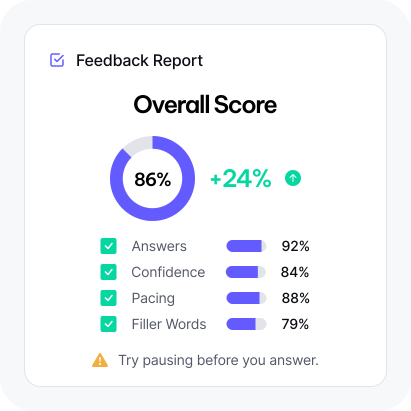
Compare like with like: similar task family, fresh prompt, similar preparation time, and similar equipment. Keep confidence, language performance, and technical quality in separate columns. If you want a deeper plan for applying feedback across a week, use IELTS Vocabulary and Grammar: Build Range Without Forcing Advanced Words.
Frequently asked questions
How long should a Part 1 answer be?
There is no single sentence count that fits every question. Aim for a direct answer with enough development to show language, then stop when the idea is complete.
Can I ask for clarification?
In real communication, clarification is valuable. For test-specific rules on what an examiner can repeat or explain, follow current official IELTS guidance and your teacher's advice.
Do I need idioms in every answer?
No. Natural, accurate language is more useful than inserting an idiom that does not fit. Build range through precise verbs, adjectives, comparisons, and paraphrase.
Practice the task, then transfer the skill
Effective test preparation develops language you can use when the wording, topic, or follow-up changes. Match the practice design to IELTS Speaking Part 1, complete the response before over-editing it, review evidence in a sensible order, and test every improvement on unfamiliar material.
With Resso for Education, learners and educators can build repeatable speaking scenarios while keeping official rules and human judgment authoritative. Start with one baseline, choose one high-impact change, and build enough varied repetitions for that change to survive the next question. Talk with Resso about language-practice coaching.