

Graduate employability is broader than job-search technique
Map Resso practice to graduate attributes
Help students articulate what their learning enables
Practice the full employment journey
Connect curriculum, career services, and employers
Use practice data to strengthen reflection
Measure employment success with a balanced framework
Resso supports graduate employability by helping students practice how they communicate disciplinary knowledge, project experience, judgment, and collaboration in interviews, networking conversations, client interactions, workplace scenarios, and professional presentations. Employability is not a promise of employment. It is a developing capacity to find, secure, enter, and contribute within opportunities.
Institutions strengthen that capacity when communication practice is embedded across the student journey rather than left to one optional workshop before graduation. Resso's education practice environment can extend repetition and feedback, while faculty, career services, employers, and alumni contribute real standards, context, and relationships.
Graduate employability is broader than job-search technique
A student may know how to submit an application and still struggle to explain what they learned, collaborate with unfamiliar colleagues, present a recommendation, handle a difficult question, or ask for feedback. Employability includes these capabilities alongside technical knowledge, experience, networks, labour-market access, and personal circumstances.
Resso is most valuable when it helps students activate what the curriculum already develops. An engineering student explains a design trade-off. A humanities student translates research into a stakeholder briefing. A business student handles a client objection. A health student practices a difficult but supervised communication moment.
Map Resso practice to graduate attributes
Begin with the institution's graduate attributes, program outcomes, accreditation requirements, and employer feedback. Identify where students must communicate, listen, adapt, collaborate, or exercise judgment. Then locate the courses and experiences where those capabilities can be rehearsed and observed.
Do not add a generic employability layer to every program. The same communication outcome should look different by discipline and audience. Resso's custom scenario builder can reflect a program's authentic context while educators verify content and professional standards.
Help students articulate what their learning enables
Employers and community partners cannot infer every capability from a course title. Students need to explain the problem they addressed, the method or tools they used, the decisions they made, the result, and what they would improve. This turns a transcript or portfolio artifact into evidence another person can understand.
Ask follow-up questions that separate contribution from participation. What did the student personally do? Which constraint changed the approach? What feedback altered the outcome? Repeated spoken answers help learners identify stronger evidence and expose where a claim needs more precision.

Practice the full employment journey
Interview preparation matters, but the journey also includes informational conversations, career fairs, portfolio reviews, assessment centres, salary questions, onboarding, team communication, and early feedback. Institutions can build a sequence that becomes more discipline-specific and consequential over time.
The guide to internships and entry-level career launches can provide context for practice. Resso then turns that guidance into action by giving students a listener, follow-ups, feedback, and another attempt.
Connect curriculum, career services, and employers
Faculty understand disciplinary quality, career practitioners understand transitions, and employers understand current workplace contexts. Co-designing scenario goals can create a stronger bridge than asking one unit to own employability. Students also need a voice in deciding which conversations feel most relevant and where barriers remain.
Employer input should improve authenticity without turning education into training for one company's preferences. Educators must protect accessibility, cultural and linguistic diversity, academic goals, and student privacy. The objective is transferable judgment, not mimicry of a single workplace style.
Use practice data to strengthen reflection
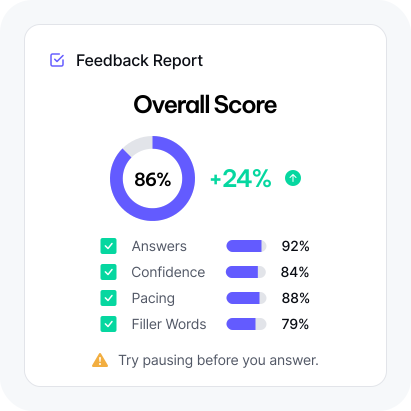
After a scenario, ask students to name the evidence they used, the feedback they accepted or questioned, and the change they made. This reflection is important because learners need to self-direct improvement after graduation, when a teacher may no longer structure every practice cycle.
Automated feedback should remain formative. Human reviewers are needed for technical accuracy, professional ethics, cultural context, disability-related differences, and high-stakes decisions. A graduate should learn to evaluate feedback, not simply comply with every signal.
Measure employment success with a balanced framework
Direct measures include practice access, performance growth, transfer to a new scenario, student reflection, and employer or supervisor observation during work-integrated learning. Transition measures may include interview invitations, offers, time to employment, job quality, role relevance, retention, and graduate confidence.
Employment outcomes are shaped by the labour market, geography, identity, networks, immigration status, program mix, and economic conditions. Institutions should disaggregate results, define job quality, and avoid attributing employment to Resso alone. The strongest evaluation connects communication growth to later outcomes while reporting limitations.
A four-week Resso implementation sequence
Week 1: define the outcome and collect a baseline. Select one near-term goal: translating disciplinary learning into relevant evidence for a professional audience. Explain the purpose to learners, show the criteria, confirm privacy and accessibility arrangements, and let each participant complete one short attempt before receiving extensive coaching. The baseline is not a grade or a prediction. It gives the learner and educator a concrete starting point and reveals whether the scenario, instructions, device access, and level of challenge are working as intended.
Week 2: teach, practice, and choose one change. Provide the knowledge, examples, vocabulary, or professional framework students need before asking them to perform. Learners then complete a Resso scenario, review feedback, and select one observable improvement that matters to the audience. They repeat only the relevant moment while it is fresh. This focused retry helps students experience cause and effect instead of treating the feedback report as a final judgment about their ability.
Week 3: vary the context and add human interpretation. Change one feature, such as the question, audience, constraint, or level of follow-up, while keeping the core skill stable. Ask faculty, career staff, and a small employer or alumni advisory group to review a sample, moderate the criteria, and identify feedback that needs context. Students should explain which suggestion they accepted, which they questioned, and what evidence supports that choice. The purpose is adaptable judgment, not compliance with every automated signal.
Week 4: transfer the skill into an authentic setting. Use a portfolio review, interview, networking conversation, capstone showcase, or employer meeting as the next test. Collect only the evidence needed to answer whether practice helped, including clearer articulation of contribution, audience adaptation, and stronger transfer into authentic career tasks. Invite students to describe what transferred and what remained difficult. A real setting may expose timing, relationship, access, or content issues that a simulation could not reproduce, so treat transfer evidence as guidance for the next design cycle rather than a verdict on the learner.
After the pilot, keep the scenario only if it adds value beyond existing instruction. Review participation and outcomes by learner group, document accommodations and missing data, and check that students reached human support when needed. Revise one element at a time, record the reason, and set a future review date. This small, transparent cycle produces a more credible implementation than launching many scenarios without knowing which conditions helped students improve.
Frequently asked questions
Does employability mean getting any job quickly?
No. A useful definition also considers job quality, alignment, sustainability, learning, and the graduate's goals and circumstances.
Can Resso replace career services?
No. It can scale practice. Career professionals provide labour-market knowledge, individual guidance, employer connections, and support for complex decisions.
Should every discipline use the same scenarios?
No. Shared capabilities can be practiced through different disciplinary audiences, decisions, evidence, and professional standards.
Can a university claim Resso caused higher employment?
Only a rigorous evaluation could support causality. Most institutions should report communication growth, contribution, association, and contextualized graduate outcomes.
Employability grows when knowledge becomes communicable
Graduates need more than strong ideas and technical knowledge. They need to make that value understandable in interviews, projects, teams, and professional relationships. Resso gives institutions a repeatable way to practice those moments.
Employment success still depends on opportunity and context. A responsible strategy connects curriculum, human career support, authentic practice, and careful outcomes measurement so more students can carry their learning into the work they want to do.