

What is communication practice in business?
Why knowledge alone is not enough
Where communication practice matters most
What weak communication readiness costs
How structured practice improves performance
Communication practice vs. courses and live role-play
How to build a practical communication practice program
Businesses need communication practice because important conversations are performance moments, not knowledge checks. An employee can understand a product, policy, or framework and still struggle to explain it clearly when a customer is frustrated, a colleague disagrees, or a leader asks an unexpected question. Structured practice gives people a safe place to rehearse realistic situations, receive focused feedback, and improve before the outcome affects a customer, teammate, or stakeholder.
The goal is not to make every conversation sound scripted. It is to help people retrieve what they know, organize it quickly, listen carefully, and respond with clarity under real conditions. That combination of knowledge and practiced judgment is what creates conversational readiness.
What is communication practice in business?
Communication practice is the repeated rehearsal of realistic workplace conversations. Employees respond in their own words, adapt to another person's questions or emotions, and review specific feedback after each attempt. A useful practice session is active, scenario-based, and close enough to the real situation that the learner must make decisions rather than recite a memorized answer.
Examples include a sales representative handling a pricing objection, a manager delivering developmental feedback, a support agent calming an upset customer, or a project lead explaining a delay to an executive. The details vary, but the learning pattern is consistent: prepare, speak, reflect, adjust, and try again.
This is different from simply reading a playbook. A playbook can explain what good communication looks like. Practice helps an employee produce it in the moment.
Why knowledge alone is not enough
Traditional training often focuses on information transfer. Employees watch a video, read a document, attend a workshop, or complete a quiz. These activities can build useful knowledge, but they do not reliably show whether someone can use that knowledge in a live conversation.
Real conversations add time pressure, emotion, ambiguity, and social risk. People must listen while planning a response. They may need to explain a complex idea without jargon, ask a follow-up question, or change direction when the other person reacts unexpectedly. Those are performance skills, and performance skills improve through repeated use.
The same principle appears in broader career development. Resso's article on future-ready career skills highlights communication as an advantage that grows through active use. For a business, the practical implication is simple: if a capability must appear in conversation, the training should include conversation.
Where communication practice matters most
Communication practice is most valuable when the conversation is frequent, important, difficult, or hard to recover from. Common business applications include:
Sales and account management: discovery calls, objections, price discussions, renewals, and executive briefings.
Customer service: complaints, policy explanations, escalation prevention, and expectation setting.
Leadership: feedback, coaching, delegation, performance conversations, and change communication.
Employee onboarding: product explanations, internal handoffs, customer introductions, and common first-month situations.
Presentations: opening clearly, answering questions, defending a recommendation, and adapting to the audience.
Cross-functional work: negotiating priorities, surfacing risks, resolving disagreement, and communicating delays.
Hiring and career development: structured interviews, candidate conversations, networking, and internal mobility.
Interview practice offers a useful example because the stakes are clear and the feedback is immediate. The article about precision interview coaching at OCEA's spring conference shows how a familiar conversation can become a repeatable practice experience. Businesses can apply the same approach to customer, manager, and stakeholder situations.

What weak communication readiness costs
The cost of weak communication rarely appears as a single line item. It shows up as avoidable rework, longer sales cycles, repeated escalations, unclear handoffs, inconsistent customer experiences, and managers postponing conversations that need to happen.
A person may know the correct answer but bury it under too much context. Another may speak confidently without checking whether the customer feels understood. A manager may soften feedback so much that the employee cannot identify what needs to change. These are not always knowledge problems. They are often practice problems.
Communication readiness also shapes employee experience. When expectations change, people notice whether leaders can explain the reasons, invite questions, and respond honestly.
How structured practice improves performance
Effective practice reduces the gap between understanding and execution. It does this through four mechanisms:
1. Retrieval: Employees must recall the right information without relying on a slide or script.
2. Adaptation: They learn to respond to questions, emotion, and incomplete information.
3. Feedback: They can identify one or two specific behaviors to improve on the next attempt.
4. Repetition: A second attempt turns feedback into action while the lesson is still fresh.
The repetition is especially important. Feedback without another attempt can remain theoretical. A short retry lets the employee test a clearer opening, ask a better question, or pause before responding. Over time, these small adjustments become more available during real conversations.
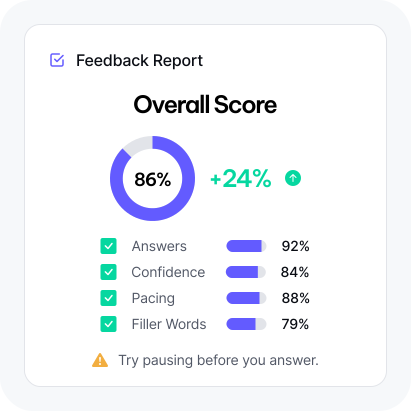
Feedback should remain focused. Too many scores or comments can distract from the behavior that matters most. A practical review might ask: Was the purpose clear? Did the employee listen and acknowledge? Was the response accurate? Did the next step make sense?

Communication practice vs. courses and live role-play
Communication practice does not need to replace courses, coaching, or live role-play. Each method solves a different part of the learning problem.
Courses and playbooks
Best for: Building shared knowledge and standards. Main limitation: Limited evidence that a learner can perform in conversation.
Manager coaching
Best for: Context, judgment, and personalized guidance. Main limitation: Manager time is limited and feedback quality can vary.
Peer or facilitator role-play
Best for: Human nuance, observation, and team discussion. Main limitation: It can be difficult to schedule and uncomfortable for beginners.
AI role-play
Best for: Private repetition, consistent scenarios, and immediate feedback. Main limitation: It needs clear scenario design and human oversight.
A blended approach is usually strongest. Teach the principle, let employees practice privately, use managers or facilitators for deeper coaching, and revisit the skill in team discussions. The first session with any coach is easier when the learner arrives with a specific goal and examples. The article on preparing for a first coaching session offers a useful model for making feedback more concrete.
How to build a practical communication practice program
Start with business moments, not a broad request to improve communication. Select one or two conversations where better performance would create visible value. Interview people who handle those situations well, and identify what they notice, ask, explain, and decide.
Then build the program in seven steps:
1. Name the moment: Define the exact conversation, audience, and desired outcome.
2. Describe the context: Include what the learner knows, what the other person wants, and what may create tension.
3. Set observable criteria: Evaluate a small number of behaviors such as clarity, listening, accuracy, empathy, and next-step alignment.
4. Create realistic variation: Change the persona, level of resistance, missing information, or time pressure.
5. Make the first attempt low risk: Private practice helps employees experiment without worrying about public failure.
6. Add human coaching where it matters: Managers can review patterns, discuss judgment calls, and connect practice to live work.
7. Repeat over time: Short, spaced practice is more useful than a single event that employees quickly forget.
Use real language from the workplace, but remove personal or confidential information. Scenarios should be specific enough to require judgment and open enough to allow more than one good answer. Avoid designing a hidden script that rewards exact phrases instead of effective communication.
What should businesses measure?
Measure whether practice changes useful behavior, not whether employees merely completed an activity. A balanced measurement plan can include:
Participation: Track participation and repeat attempts.
Skill improvement: Review progress on a small set of observable communication criteria.
Manager observation: Look for changes during real work.
Confidence with evidence: Pair employee confidence with demonstrated skill.
Business indicators: Monitor relevant signals such as avoidable escalations, handoff quality, or time to readiness.
Do not treat a single score as a complete judgment of a person. Communication is contextual, and different roles require different styles. Use practice data to guide coaching, identify common training needs, and evaluate whether the scenario itself is useful.
It is also important to state how recordings, transcripts, and performance data will be handled. Employees should know what is collected, who can see it, how long it is retained, and how it will be used. Clear governance supports trust and keeps a development program from feeling like hidden surveillance.
Where AI role-play fits
AI role-play is most useful when a business needs private repetition, flexible access, consistent scenarios, or practice across a distributed team. It can let an employee try a conversation at a convenient time, receive immediate feedback, and repeat the scenario without waiting for a manager or partner.
It works best as part of a broader learning system. A platform such as Resso can provide lifelike conversation practice and structured feedback, while managers provide context, judgment, and reinforcement. The technology handles practice volume. People remain responsible for standards, coaching, and decisions.
Before adopting any AI practice tool, review scenario quality, accessibility, language support, privacy controls, data handling, feedback transparency, and the ability to align criteria with the role. Run a small pilot with one conversation and a clear success definition before expanding.
Frequently asked questions
What is the purpose of communication practice at work?
The purpose is to help employees turn knowledge into clear action during real conversations. Practice builds retrieval, listening, judgment, and adaptability under realistic conditions. It also gives employees a safe place to make mistakes and improve before a customer, colleague, candidate, or stakeholder is affected.
Which employees benefit from communication practice?
Any employee whose work depends on conversation can benefit. Common groups include sales representatives, customer service teams, managers, new hires, recruiters, project leaders, presenters, and subject-matter experts who must explain complex information to non-experts.
How often should employees practice communication skills?
Short, repeated sessions are generally more practical than a single annual workshop. Frequency should match the importance and complexity of the conversation. A new skill may need weekly practice at first, followed by refreshers before important events or when products, policies, or responsibilities change.
Can communication practice feel too scripted?
Yes, if the activity rewards exact wording. Good practice defines an outcome and observable behaviors while allowing the employee to respond naturally. Variation in questions, personas, and context helps learners build adaptability instead of memorizing a script.
Is AI role-play a replacement for manager coaching?
No. AI can make repetition and immediate feedback more available, but managers add organizational context, professional judgment, and accountability. The strongest programs use AI for practice volume and human coaching for interpretation, nuance, and connection to real work.
How can a business start without creating a large program?
Choose one high-value conversation, define three to five observable behaviors, create two realistic scenarios, and run a short pilot with a small group. Ask participants and managers whether the practice resembles real work, then improve the scenarios before expanding.
Practice before the outcome is at risk
Businesses already expect employees to communicate well in moments that affect revenue, trust, retention, and execution. The missing step is often a safe and repeatable way to prepare for those moments. When communication practice is realistic, focused, and connected to coaching, employees can build readiness before the conversation counts.
.jpeg)
.jpeg)