

Start with a simple theory of change
Define the communication outcome before the metric
Measure reach, access, and practice dosage
Measure skill growth directly across attempts
Look for transfer into authentic school tasks
Connect cautiously to attendance, completion, graduation, and transition outcomes
Turn the evaluation into an improvement cycle
A four-week Resso implementation sequence
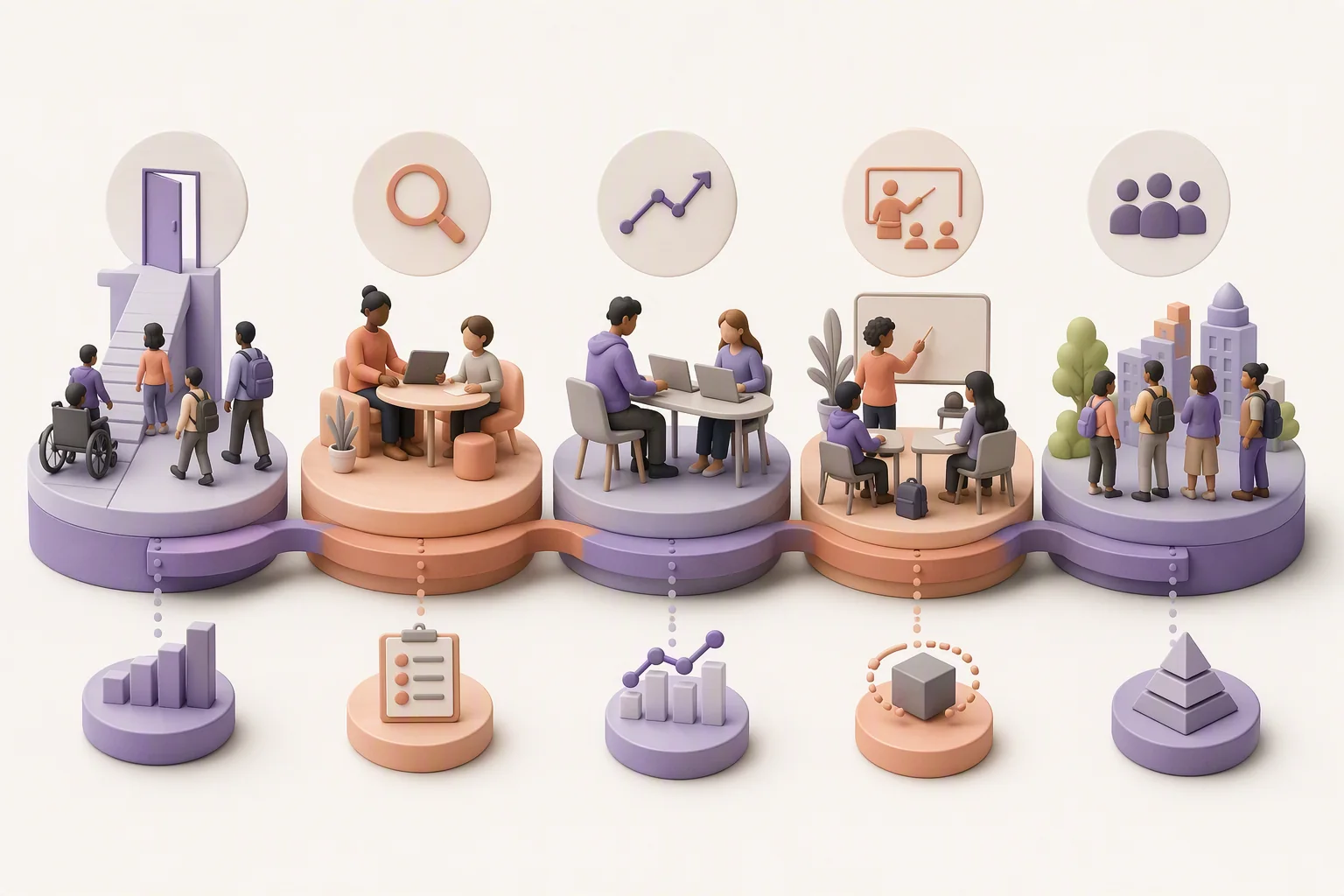
Credible results connect practice to outcomes one step at a time
K-12 schools should measure Resso by connecting implementation, practice quality, skill growth, classroom transfer, and student outcomes, while avoiding claims that a single tool caused changes in grades, attendance, graduation, or employment. A useful evaluation begins with a clear learning problem and gathers evidence close enough to the intervention that educators can act on it.
Logins and completed scenarios describe reach, not impact. Resso's education practice environment creates opportunities for repetition and feedback. Schools still need to determine whether the right students participated, whether communication improved, whether skills transferred, and whether the implementation was equitable and sustainable.
Start with a simple theory of change
Write the expected chain before collecting data. For example: students receive realistic speaking opportunities, use focused feedback, improve a defined communication behavior, participate more effectively in a course or transition, and become better prepared for a later outcome. Each link needs an observable indicator.
This chain prevents a leap from usage to graduation. It also shows where the program may be breaking down. If students log in but rarely repeat a scenario, feedback may not be actionable. If practice improves but classroom transfer does not, learners may need a structured bridge to a real discussion, interview, or presentation.
Define the communication outcome before the metric
Choose a narrow outcome such as explaining evidence, responding to a follow-up question, asking for clarification, or structuring an interview example. Avoid labels such as confidence or professionalism unless the school defines what they mean and confirms that the definition is fair across cultures, disabilities, languages, and age groups.
Build the scenario and rubric around that outcome using Resso's scenario-based practice options. A small set of stable criteria makes growth easier to interpret than a dashboard full of unrelated signals. Teachers should be able to explain each measure to students and families in plain language.
Measure reach, access, and practice dosage
Track how many eligible students begin, complete, and repeat the intended practice cycle. Record whether sessions occur before the real task and whether students receive enough time, devices, bandwidth, accessibility supports, and instructional preparation. These conditions explain whether outcome data represent the program or only the easiest participants to reach.
Disaggregate access by grade, course, school, language status, disability status where lawful and appropriate, and other locally relevant groups. The goal is to identify gaps, not rank students. A high average completion rate can hide a group that rarely receives a second attempt or cannot use the tool under current conditions.
Measure skill growth directly across attempts
Use a pre-practice attempt, focused feedback, and a later comparable attempt. Score only a few observable criteria and preserve a small sample for human moderation when policy allows. Student reflection can add whether the feedback made sense and which change they intentionally made.
The article on turning feedback into a development plan offers a useful principle: the measure matters when it changes the next action. Growth between attempts is stronger evidence of learning than the final score alone.
Look for transfer into authentic school tasks
Ask teachers, students, counselors, and placement supervisors whether the practiced behavior appears during live presentations, discussions, conferences, interviews, labs, or work-based learning. Use short rubrics or structured observations that match the practice criteria rather than general impressions.
Transfer can also be tested by changing the audience or scenario while keeping the skill constant. If a student can clarify an instruction only in the original simulation, the response may be memorized. If the learner adapts the strategy in a new setting, the skill is more likely to be usable.
Connect cautiously to attendance, completion, graduation, and transition outcomes
Schools may examine course completion, attendance, credit accumulation, graduation, postsecondary enrollment, placement success, or employment alongside Resso participation. These are important outcomes, but they are influenced by instruction, relationships, finances, health, transportation, opportunity, policy, and many other factors.
Use cautious language such as association or contribution unless the evaluation design supports a stronger claim. Compare similar groups when possible, document other initiatives, and include qualitative evidence explaining the pathway. A transparent finding such as 'communication readiness improved and students reported better preparation' is more credible than an unsupported graduation claim.
Turn the evaluation into an improvement cycle
Review data with educators and students at a predictable interval. Identify one scenario that works, one group with limited access, one feedback category that confuses learners, and one place where transfer is weak. Assign an owner and a date for each change.
Report both benefits and limitations. Include sample size, participation, accommodations, missing data, and whether results were self-reported or independently observed. The strongest results story shows what changed, for whom, under which conditions, and what the school will improve next.
A four-week Resso implementation sequence
Week 1: define the outcome and collect a baseline. Select one near-term goal: testing one defined communication behavior and the quality of its measurement. Explain the purpose to learners, show the criteria, confirm privacy and accessibility arrangements, and let each participant complete one short attempt before receiving extensive coaching. The baseline is not a grade or a prediction. It gives the learner and educator a concrete starting point and reveals whether the scenario, instructions, device access, and level of challenge are working as intended.
Week 2: teach, practice, and choose one change. Provide the knowledge, examples, vocabulary, or professional framework students need before asking them to perform. Learners then complete a Resso scenario, review feedback, and select one observable improvement that matters to the audience. They repeat only the relevant moment while it is fresh. This focused retry helps students experience cause and effect instead of treating the feedback report as a final judgment about their ability.
Week 3: vary the context and add human interpretation. Change one feature, such as the question, audience, constraint, or level of follow-up, while keeping the core skill stable. Ask an instructional lead, teacher, and representative student group to review a sample, moderate the criteria, and identify feedback that needs context. Students should explain which suggestion they accepted, which they questioned, and what evidence supports that choice. The purpose is adaptable judgment, not compliance with every automated signal.
Week 4: transfer the skill into an authentic setting. Use an authentic classroom, counseling, presentation, or career-readiness moment as the next test. Collect only the evidence needed to answer whether practice helped, including equitable access, measurable growth, transfer, and a transparent account of limitations. Invite students to describe what transferred and what remained difficult. A real setting may expose timing, relationship, access, or content issues that a simulation could not reproduce, so treat transfer evidence as guidance for the next design cycle rather than a verdict on the learner.
After the pilot, keep the scenario only if it adds value beyond existing instruction. Review participation and outcomes by learner group, document accommodations and missing data, and check that students reached human support when needed. Revise one element at a time, record the reason, and set a future review date. This small, transparent cycle produces a more credible implementation than launching many scenarios without knowing which conditions helped students improve.
Frequently asked questions
Are logins a measure of impact?
They measure reach or activity. Impact requires evidence of skill growth, transfer, student experience, or another defined outcome.
Can a school say Resso increased graduation rates?
Only a rigorous evaluation could support a causal claim. Most schools should describe contribution, association, and leading indicators while acknowledging other influences.
What is the best first outcome to measure?
Choose the communication behavior closest to the scenario, then compare performance across attempts and in one authentic task.
Why disaggregate the results?
Overall averages can hide unequal access, feedback quality, or benefit. Group-level review helps the school improve implementation fairly.
Credible results connect practice to outcomes one step at a time
Resso evaluation should begin close to the learning experience: who practiced, what changed, and whether the skill appeared in a real setting. Those answers are useful to teachers and leaders because they point directly to improvement.
Longer-term outcomes still matter, including completion, graduation, and transition success. Schools build trust when they connect them cautiously, disclose limitations, and treat measurement as a learning process rather than a search for the largest claim.