
Why oral evidence matters for this assessment
Define the learning evidence before choosing the technology
Design an opening prompt that requires thinking
Plan follow-up questions that test depth and transfer
Combine written and spoken evidence instead of choosing one
Build a focused rubric around knowledge and reasoning
Design access and fairness into the assessment
Use Resso for a practice, feedback, and retry cycle
Run a responsible pilot before expanding
Compare practical oral exam models for universities and colleges, including brief diagnostics, assignment defenses, case conversations, and staged viva assessments.
Generative AI has made written language easier to produce, but it has not made learning easier to verify. For college and university faculty, academic integrity leaders, and teaching innovation teams, oral assessment can add a direct, conversational view of what a student understands. Resso helps make that approach repeatable through educator-defined scenarios, controlled questions, practice, feedback, and review.
This article focuses on a post-secondary program seeking authentic evidence without scheduling a traditional faculty viva for every student. The aim is a proportionate assessment that protects academic standards while giving students a fair chance to explain, clarify, and improve.
Why oral evidence matters for this assessment
The central challenge is not whether a student can produce a polished response. It is whether the educator can see the knowledge and reasoning that the response is meant to represent. For a post-secondary program seeking authentic evidence without scheduling a traditional faculty viva for every student, a short oral exchange adds direct evidence without requiring educators to abandon valuable written, visual, mathematical, or practical work.
Spoken evidence is useful because ideas have to be retrieved, connected, and adapted in real time. A student can pause and think, but they cannot rely only on a finished paragraph. The goal is not surprise. It is to hear disciplinary knowledge, reasoning, evidence, response to challenge, and transfer under a task appropriate to the course level. The broader guide, How to Scale Oral Assessment in Large Classes Without Multiplying Faculty Workload, explains how this evidence fits an assessment system rather than a one-off activity.
Define the learning evidence before choosing the technology
Begin with the course outcome and ask what observable evidence would justify a conclusion about learning. In this use case, the priority is disciplinary knowledge, reasoning, evidence, response to challenge, and transfer under a task appropriate to the course level. Write that evidence in language that students, educators, and reviewers can recognize. If the outcome is conceptual understanding, do not quietly turn the task into a test of charisma or rapid speech.
Decide what the oral response adds that the existing assignment cannot show clearly. It may expose how evidence was selected, whether a method is understood, how a learner handles a counterexample, or where a misconception begins. Scaling the conversation should not scale opacity; students need to know what is assessed, how evidence is used, and how to seek review. This boundary keeps the assessment valid and gives students a fair explanation of why they are being asked to speak.
Design an opening prompt that requires thinking
A useful opening prompt is broad enough to reveal a student's mental model and specific enough to stay aligned with the curriculum. For this topic, a strong starting point is: Explain and defend a course-relevant decision, then respond when one assumption, variable, or stakeholder perspective changes. That wording asks for a claim and a reason, not a rehearsed definition.
Educators can use Resso's custom scenario builder to set the role, context, learning objective, tone, and success criteria. Keep the scenario grounded in material students were expected to learn. A realistic context can improve relevance, but extra narrative detail should not become an unrelated reading or cultural-knowledge barrier. For more question-design principles, see Business Case Defenses: Hear the Judgment Behind the Recommendation.
Plan follow-up questions that test depth and transfer
The first answer is a starting point. Follow-up questions can ask for evidence, clarify a vague statement, introduce a counterexample, or change one condition. Appropriate probes for this use include: What is your evidence? What is the strongest counterargument? What would an expert in another field need clarified? Each probe should connect to a rubric criterion rather than reward improvisation for its own sake.
Resso's full question control can help educators add, edit, reorder, and randomize questions. Adaptation still needs limits. Define which probes are clarifications, which increase difficulty, and how many each student should receive. Comparable challenge is more defensible than an unbounded conversation in which some learners face much harder questioning than others.
Combine written and spoken evidence instead of choosing one
Choose a model that fits the assessment purpose: a short diagnostic, an assignment defense, a role-play, a case conversation, or a final viva. Written work remains valuable for sustained analysis, source use, revision, notation, and complex composition. Oral assessment contributes a different window into retrieval, reasoning, ownership, and response to questions.
A balanced design can include a written or practical artifact, a brief process note, a spoken explanation, and a chance to revise. These pieces should support one another. An inconsistency is a reason to ask a careful question, not automatic proof of misconduct. How to Measure Oral Assessment Reliability, Fairness, and Learning Impact offers a complementary view of how multiple evidence sources can improve academic integrity and fairness.
Build a focused rubric around knowledge and reasoning
For this task, useful criteria include disciplinary accuracy, reasoning, source use, adaptation, and professional or academic communication only where those outcomes are explicit. Keep the rubric short enough to guide the conversation. Describe observable differences between performance levels instead of relying on labels such as excellent, confident, or professional that can hide personal preference.
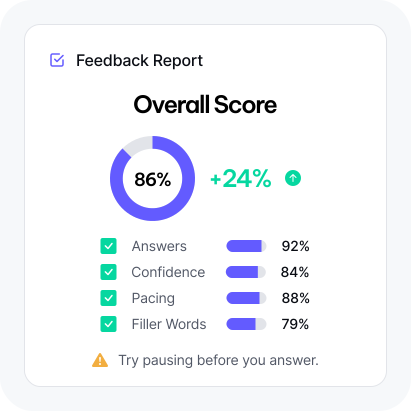
Resso's editable evaluation criteria can align practice and feedback with educator-defined expectations. Automated feedback can help students notice patterns and choose a next step, but the educator remains responsible for content standards and final judgments. Moderate a sample of responses, compare interpretations, and revise ambiguous descriptors before the task carries significant weight.
Design access and fairness into the assessment
Publish the format, calibrate challenge, provide accommodations, monitor subgroup outcomes, and preserve faculty review for contested or consequential results. Explain the recording, transcript, retention, and review process in plain language. Students should know what is collected, who can see it, how long it is needed, and how to request help or challenge an error.
Resso offers closed captions and accessibility options as well as turn-based conversation mode for structured practice. Those capabilities support access, but they do not replace institutional accommodation processes or educator judgment. Review participation and outcome patterns to see whether the design creates avoidable barriers.
Use Resso for a practice, feedback, and retry cycle
A strong workflow begins with a transparent scenario and a low-stakes first attempt. Students speak with a responsive practice partner, review feedback aligned with the task, choose one content change and one communication change, and try the relevant part again. Repetition is purposeful when each attempt tests a specific improvement.
The Resso Education platform supports custom scenarios, class sharing, lifelike conversations, feedback, and educator visibility. Use it as a structured layer within teaching, not as a substitute for instruction. Students still need course content, worked examples, feedback from qualified people, and authentic opportunities to transfer what they practiced.
Run a responsible pilot before expanding
Start with one course, one oral model, and one clear decision about what the new evidence will change. Explain the purpose, publish the criteria, test devices and access, and collect a baseline before extensive coaching. Review a sample of transcripts or recordings only when policy permits and only for the educational purpose students were told about.
Evaluate validity of evidence, faculty workload, scoring consistency, student access, policy clarity, and improvement in later course performance. The existing Resso article on a related Education implementation and measurement question provides additional context for connecting practice evidence to human review. Expand only after the team can explain what improved, what remained uncertain, who experienced barriers, and which safeguards need revision.
A four-step implementation sequence
Step 1: define and disclose. Identify the target evidence: disciplinary knowledge, reasoning, evidence, response to challenge, and transfer under a task appropriate to the course level. Document the data needed, the criteria, the role of automated feedback, and the person responsible for the final judgment. Give students the prompt purpose and format before the first attempt.
Step 2: practice before grading. Use a short Resso scenario based on this prompt: Explain and defend a course-relevant decision, then respond when one assumption, variable, or stakeholder perspective changes. Let students learn the controls, experience a follow-up, review feedback, and make one targeted retry without a high-stakes consequence.
Step 3: collect comparable evidence. Use a common opening, bounded follow-ups, and the focused rubric. Preserve approved accommodations and route exceptions to a person who understands the course, the learner, and the institutional policy.
Step 4: review and improve. Examine the following evidence: validity of evidence, faculty workload, scoring consistency, student access, policy clarity, and improvement in later course performance. Document limitations as carefully as positive findings. Change one design element at a time so the team can see which adjustment improved learning, access, or efficiency.
Frequently asked questions
Does oral assessment prove that a student did not use generative AI?
No. It provides additional evidence of understanding, process, and ownership. Educators should combine that evidence with clear AI-use expectations, the submitted work, and fair academic procedures.
Should every oral response receive a grade?
No. Frequent low-stakes checks can be formative. When a response is graded, students need advance notice, clear criteria, accommodations, and an appropriate review process.
How long should the conversation be?
Use the shortest conversation that can gather the intended evidence. For college and university faculty, academic integrity leaders, and teaching innovation teams, many focused checks can be brief, while capstones or professional scenarios may require a longer staged assessment.
Can Resso make the final grading decision?
Resso can support practice, structured questions, transcripts, feedback, and rubric-aligned evidence. Qualified educators should retain responsibility for final grades, accommodations, appeals, and consequential decisions.
Use conversation to strengthen the evidence of learning
Oral assessment is most valuable when it makes thinking visible without confusing speaking style with intelligence. In this context, the strongest design gathers disciplinary knowledge, reasoning, evidence, response to challenge, and transfer under a task appropriate to the course level and gives the learner a clear route from first attempt to better understanding.
Resso can help college and university faculty, academic integrity leaders, and teaching innovation teams create that repeatable conversation while keeping teachers and institutions in control of the criteria and decisions. Start with one purposeful task, listen to the evidence, improve the design, and expand only when the learning and access results justify it. Book an Education demo to explore a pilot.