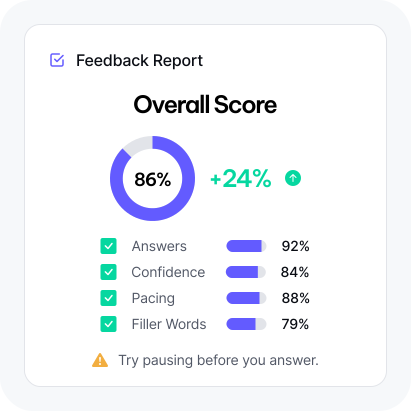


Employee onboarding builds role readiness when new hires practice the conversations, decisions, and handoffs their work requires before they are expected to manage them alone. Course completion can confirm that information was presented. It cannot confirm that a person can explain the product, respond to a customer, ask for help, lead a handoff, or navigate a difficult internal conversation.
A readiness-based onboarding program connects knowledge to performance. It identifies a small set of real moments, gives the new employee context and examples, provides safe rehearsal, and increases responsibility as evidence grows. This creates a clearer path for the learner and a better basis for managers deciding when support can decrease.
What is role readiness in employee onboarding?
Role readiness is the ability to perform defined parts of a job with the appropriate level of quality, judgment, and support. It is not complete mastery. A new hire can be ready for a standard customer inquiry while still needing help with an unusual escalation. They can be ready to present a project update while still learning the organization's strategic context.
Readiness should be described through observable work. “Understands the sales process” is difficult to evaluate. “Can open a discovery conversation, clarify the buyer's goal, and document a useful next step” is more concrete.
The article on why businesses need communication practice explains why this distinction matters. Employees do not use policies and product knowledge in isolation. They use them while another person is asking, reacting, or waiting.
Why content completion is not enough
Onboarding systems are good at delivering consistent information. They can show that a new hire watched a video, opened a document, or passed a quiz. These signals are useful for administration and compliance, but they are weak evidence of performance under normal job conditions.
A learner may select the correct response to a customer question and still struggle to explain it without jargon. They may know the escalation policy and still wait too long to ask for help. They may understand the team structure and still be unsure how to disagree with a senior colleague.
When completion is mistaken for readiness, the first real attempt becomes the assessment. The cost appears in customer experience, rework, manager intervention, employee anxiety, and slower confidence. Safe rehearsal moves that discovery earlier.
Map the moments that define the role
Ask experienced employees and managers which situations distinguish a new hire who can contribute from one who still needs close support. Focus on recurring moments with meaningful consequences.
Customer-facing moments: opening a call, explaining a process, handling a common concern, setting expectations, or escalating safely.
Internal moments: asking for clarification, reporting a risk, handing off work, giving an update, disagreeing respectfully, or requesting a decision.
Knowledge moments: explaining why a policy exists, comparing options, identifying missing information, or locating the approved source.
Judgment moments: deciding when a standard response is enough and when the situation requires another person.
Turn these moments into a readiness map. Do not launch dozens at once. Choose the few that unlock safe participation in the role and add complexity later.

Build progressive practice milestones
Each milestone should combine preparation, observation, rehearsal, feedback, and transfer. A new support employee might first review the policy and hear an example, then practice a common request, shadow a live interaction, handle a low-risk case with support, and finally work independently with review.
Progression should change one meaningful variable at a time. Begin with clear information and a cooperative counterpart. Later, introduce ambiguity, emotion, time pressure, or multiple priorities. New hires learn more when they can identify why a later scenario is harder.
Set a visible standard for each milestone. The learner should know which facts must be accurate, which behaviors matter, where flexibility is allowed, and what requires escalation. This reduces the feeling that readiness depends on a manager's unspoken impression.
Connect milestones to the calendar without assuming every learner develops at the same speed. A target week can help teams plan access and supervision, but the evidence should determine responsibility. Someone with prior industry experience may move quickly through a familiar conversation and need more time with internal systems. Another person may learn the system quickly and need extra spoken practice. A flexible path is more credible than declaring everyone ready on day thirty regardless of performance.
Show new hires the complete path at the beginning. Knowing which moments will be practiced, how feedback works, and who decides readiness reduces mystery. It also allows learners to prepare questions and request accommodations before a high-pressure milestone.
Use feedback that improves the next attempt
New hires already carry a heavy cognitive load. Feedback should reduce confusion, not add a long list of flaws. Preserve one thing that worked, choose one or two changes, and provide another attempt quickly.
For example, a manager might say, “Your explanation was accurate and the customer knew the next step. On the next attempt, ask one question before explaining so you can choose the relevant policy.” The learner knows what to keep and what to change.
Invite self-review. Ask what felt uncertain, what information was difficult to retrieve, and what the learner would do differently. The habit supports the kind of ongoing ownership described in building a personal development plan that lasts.
Protect manager time with a coaching ladder
Managers should not have to play every practice partner or review every attempt. Use a coaching ladder. New hires can begin with self-guided or AI practice, move to peer rehearsal, bring selected moments to a coach, and perform live work with supervision where risk requires it.
Manager attention should concentrate on judgment, context, and patterns. If a learner repeatedly misses the same product fact, the content or retrieval system may need work. If they know the fact but cannot use it in conversation, targeted rehearsal may help. If the scenario reveals a policy conflict, leadership needs to resolve the system.
Create clear escalation routes for the learner. Asking for help is part of readiness, especially in regulated, technical, or customer-sensitive work. A program that rewards confident guessing teaches the wrong lesson.
Measure time to readiness responsibly
Time to readiness can be more useful than time to course completion, but only if readiness is defined fairly. Use several sources: practice performance, supervised work, manager observation, knowledge checks, learner reflection, and operational outcomes when enough data exists.
Avoid one universal score for complex roles. Track readiness by moment or capability. A person may be independent in routine conversations and still developing in escalation, negotiation, or executive communication.
Compare employees carefully. Different territories, languages, accommodations, prior experience, schedules, and case complexity affect the evidence. Use data to provide support and improve onboarding, not to create a race that encourages people to hide uncertainty.
Future-ready organizations also treat learning agility as a durable capability. The guide to skills for the next decade provides broader context for onboarding people to learn and communicate as work evolves.
Frequently asked questions
How many scenarios should onboarding include?
Start with the highest-value moments that unlock safe work. Three to five well-designed scenarios may be more useful than a large library no one repeats.
Should practice happen before or after shadowing?
Both can help. Early practice gives the learner something to notice during shadowing. Later practice lets them apply what they observed before taking responsibility.
Can a new hire fail a practice scenario?
A scenario can show that more preparation is needed, but early attempts should be developmental. The learner needs clear criteria, feedback, and another opportunity.
What if managers disagree about readiness?
Return to observable standards, compare evidence, and identify whether the disagreement concerns risk, quality, or personal preference. Calibrate with sample responses.
Does role-readiness onboarding replace probation or formal evaluation?
No. It can provide better developmental evidence, but organizations must still follow employment policy, legal requirements, accommodations, and fair review processes.
Onboarding should end with evidence of useful work
New hires do not need another finish line that says content was consumed. They need a path from information to contribution. Scenario practice makes that path visible by connecting role knowledge to the moments where employees must explain, listen, decide, and ask for help.
Map the moments that define the role, create progressive milestones, give focused feedback, and increase responsibility as evidence grows. Use managers for context and judgment while protecting their time with a coaching ladder. The result is onboarding that builds confidence honestly because the employee has practiced the work that confidence is supposed to support.
.jpeg)
.jpeg)