

What is AI role-play in the workplace?
Start with a specific learning purpose
Govern scenarios, personas, and feedback
Define what humans remain responsible for
Earn employee trust through practical transparency
Protect fairness, accessibility, and multilingual quality
Run a pilot with success and stop conditions
Responsible workplace AI role-play requires a defined learning purpose, minimal data collection, human-reviewed scenarios and feedback, clear employee information, appropriate alternatives, and ongoing monitoring. The technology can expand access to private, repeatable practice, but it should not become an invisible performance-surveillance system or an automated judge of personality.
Employee trust depends less on a promise that the system is “responsible” and more on concrete answers. What is being practiced? What data is captured? Who can see it? How long is it kept? What decisions can it influence? How can an employee challenge an inaccurate result? Governance should answer these questions before rollout.
What is AI role-play in the workplace?
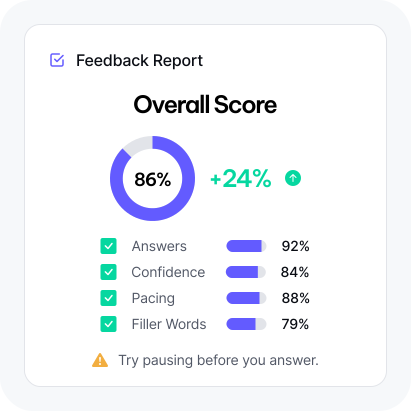
AI role-play uses an interactive model, voice, or avatar to simulate a workplace conversation. Employees may rehearse a sales call, customer issue, presentation, interview, coaching conversation, negotiation, or onboarding moment. The system responds to the learner and may provide feedback.
The value comes from availability and repetition. A person can practice privately, receive a consistent scenario, and try again without requiring a manager to play every role. AI can widen the practice opportunity, but the organization remains responsible for the learning design and consequences.
The article on why communication practice matters for businesses provides the educational rationale. Governance ensures that the method supports that purpose without creating disproportionate risk.
Start with a specific learning purpose
“Use AI for training” is not a sufficient objective. A responsible use case names the employees, conversation, current barrier, practice activity, and evidence that would show value. For example: help new support specialists rehearse explaining a delayed order and choosing the correct escalation path.
Test whether AI adds something necessary. A peer exercise, manager coaching, recording, or written case may be better for some goals. AI is most useful where repeated interaction, flexible access, consistent scenarios, or immediate formative feedback provides a clear benefit.
Limit the initial scope. A narrow pilot is easier to review for learning value, privacy, accessibility, accuracy, and employee experience. It also creates a real decision point before expansion.
Map and minimize the data
Document what the system collects and produces: account information, prompts, voice, video, transcripts, scores, feedback, device data, and usage analytics. Identify where each type is processed, who can access it, whether it trains models, and when it is deleted.
Collect only what the learning purpose requires. Video may be unnecessary for a listening exercise. Full transcripts may be unnecessary after feedback is delivered. Manager access to every private attempt may reduce psychological safety without adding value.
Use fictionalized scenarios and prohibit unnecessary confidential information. Employees should not paste customer records, unpublished financial information, health details, legal strategy, or identifiable colleague cases into an unapproved system.

Govern scenarios, personas, and feedback
Scenario owners should verify facts, approved claims, policies, tone, difficulty, and evaluation criteria. A realistic character does not need to manipulate, insult, or imitate a real person. Avoid unnecessary sensitive attributes and stereotypes.
Test how the system responds when the learner asks an unexpected question, provides false information, shares sensitive data, or leaves the scenario. Guardrails should keep the interaction within the approved purpose and provide a safe exit.
Review feedback for accuracy, relevance, and bias. A fluent explanation may still be wrong. A high score may reward one communication style. Human reviewers should compare outputs across accents, languages, disabilities, roles, and response strategies.
Define what humans remain responsible for
AI can deliver a scenario and formative observations. Humans remain responsible for approving content, interpreting context, supporting employees, correcting errors, and making consequential decisions.
Managers should know the limits of the score and when to review evidence. Learning teams should own scenario quality and calibration. Privacy, security, HR, legal, accessibility, and employee representatives may need defined review roles depending on the use case.
Do not allow automated output to become the sole basis for hiring, promotion, discipline, compensation, or termination. The ethical decision-making principles in workplace ethics when no one is watching are relevant: accountability cannot be delegated to a tool.
Earn employee trust through practical transparency
Explain the program in language employees can use. State the purpose, expected time, data collected, visibility, retention, scoring, and whether participation affects employment decisions. Make the policy available before the first session, not inside a long agreement at the final click.
Give employees a way to preview the experience, ask questions, report harmful output, and challenge inaccurate feedback. Where possible, let them repeat privately before choosing what to share with a manager.
Offer an appropriate alternative when the tool is inaccessible, unsafe for the employee's situation, or not necessary for the learning goal. The alternative should support the same outcome without marking the employee as less committed.
Managers need the same clarity. Train them on what they can access, how feedback should be discussed, and which inferences are prohibited. A technically sound privacy policy will not create trust if a manager casually asks to see private attempts or treats a formative score as a performance rating.
Protect fairness, accessibility, and multilingual quality
Test keyboard navigation, screen readers, captions, transcripts, audio controls, camera requirements, processing time, device access, and compatibility with assistive technology. A lifelike avatar is not automatically the most accessible mode.
Test speech recognition and feedback across accents and languages with qualified reviewers. Evaluate whether the system mistakes communication difference for communication weakness. Criteria should focus on understandable, appropriate performance rather than conformity to one accent or personality.
Include accommodation and support processes. Employees should know who can adjust the format, timing, or evidence without forcing them to disclose more than necessary to a manager.
Document those routes clearly.
Run a pilot with success and stop conditions
Define what would justify expansion: useful repetitions, improved performance on relevant criteria, positive employee understanding, manageable workload, acceptable accessibility, and no unresolved material risks.
Also define stop conditions. Pause if the system produces harmful or inaccurate content, performs unequally across groups, encourages sensitive disclosure, lacks a necessary control, or does not improve the learning process.
Collect qualitative and quantitative evidence. Practice completion and score movement are not enough. Review employee feedback, manager observations, samples of automated feedback, reported problems, and transfer into work.
Connect the pilot to a real development process. The article on building a personal development plan that sticks offers a useful model for turning feedback into a specific next action instead of a permanent label.
Monitor the program after launch
Models, vendors, policies, and business content change. Re-test scenarios after material updates. Review incidents, access logs, deletion, feedback accuracy, participation patterns, and employee complaints.
Establish an owner and review schedule. Remove outdated scenarios. Correct evaluation criteria when they reward the wrong behavior. Revisit data collection when a feature is no longer used.
Report what changed and why. Trust is stronger when governance is visible as an operating practice rather than a one-time approval. Employees should be able to see that feedback about the system leads to action.
Frequently asked questions
Should AI role-play practice be mandatory?
That depends on the learning need, risk, policy, and available alternatives. Mandatory use requires especially clear purpose, accessibility, privacy, and fair review.
Can managers see private practice attempts?
Only if the program clearly defines that access and it is necessary. Learner-selected sharing or aggregated patterns may support development with less intrusion.
Can AI feedback be used in performance reviews?
Formative feedback should not quietly become high-stakes evidence. Consequential use requires validation, transparency, human review, accommodations, and appropriate legal and HR governance.
How should companies handle confidential information?
Use approved systems, data-loss controls, fictional scenarios, clear employee guidance, access limits, and deletion. Do not require sensitive customer or employee details for practice.
Who should own AI role-play governance?
A named business and learning owner should coordinate with security, privacy, HR, legal, accessibility, and employee stakeholders. Responsibility should not sit only with the vendor.
Trust is part of the learning infrastructure
AI role-play can create practice opportunities that were previously difficult to schedule or scale. That benefit depends on employees believing the system is designed to help them learn and that the organization will use the evidence responsibly.
Start with a narrow purpose, minimize data, review scenarios and feedback, keep consequential judgment human, provide transparency and alternatives, and monitor the program over time. Governance is not a barrier added after innovation. It is the infrastructure that allows useful practice to continue with credibility.
.jpeg)