

Define what personalization should accomplish
Build a modular scenario architecture
Let participants supply only useful context
Reserve advisers for judgment and complexity
Design escalation into every digital pathway
Use data to improve the service, not rank people
Scale gradually across cohorts and regions
Personalization at scale comes from relevant choices, adaptive practice, and timely human interpretation—not from pretending every participant needs a fully unique program. The value appears when the workflow is designed around a real decision and a respectful human experience, not when technology is added to an unclear process.
This guide is for outplacement providers serving large cohorts across roles, sectors, locations, and career stages. It positions Resso as a structured practice and evidence layer inside a broader system led by qualified people. The platform can make realistic repetition more available, while career advisers retain responsibility for context, support, and every consequential decision.
Define what personalization should accomplish
Advisers have limited appointment time, while participants need repeated practice for different audiences and opportunities between coaching sessions. Begin by writing down the decision this part of the process is meant to support. Name the audience, the evidence required, and what must remain outside the scope. That discipline keeps the provider from solving a broad people problem with a narrow communication signal.
Use a concrete example before expanding the program. Show what information is available, what remains uncertain, which behaviour matters, and where human judgment enters. Participants should be able to explain the purpose in plain language and understand what happens after the interaction.
Evidence should lead to a decision about the process, not a label about the person. Review the result with the relevant humans, document exceptions and missing data, and preserve a route for clarification. That makes improvement possible without pretending the tool can understand the complete career transition context.
Build a modular scenario architecture
A useful design is a modular library organized by transition stage, role family, conversation type, difficulty, and the human support available after practice. Make the instructions concrete enough that participants know what success requires, but do not prescribe one personality, accent, or polished style. Test whether the same prompt remains understandable when experience, confidence, language, or access conditions change.
Use a concrete example before expanding the program. Show what information is available, what remains uncertain, which behaviour matters, and where human judgment enters. Participants should be able to explain the purpose in plain language and understand what happens after the interaction. The broader resource on Resso's business communication practice environment provides additional context for this part of the design.
Evidence should lead to a decision about the process, not a label about the person. Review the result with the relevant humans, document exceptions and missing data, and preserve a route for clarification. That makes improvement possible without pretending the tool can understand the complete career transition context.
Let participants supply only useful context
In practice, participants choose a relevant scenario, add verified context, complete a focused attempt, and bring one question or pattern to their next adviser session. Use short loops. A first attempt reveals the current pattern, targeted guidance makes one change visible, and a second attempt tests whether the change improved the response. Repetition should build adaptable judgment rather than a memorized performance.
Use a concrete example before expanding the program. Show what information is available, what remains uncertain, which behaviour matters, and where human judgment enters. Participants should be able to explain the purpose in plain language and understand what happens after the interaction. The broader resource on Resso's custom scenario builder provides additional context for this part of the design.
Evidence should lead to a decision about the process, not a label about the person. Review the result with the relevant humans, document exceptions and missing data, and preserve a route for clarification. That makes improvement possible without pretending the tool can understand the complete career transition context.

Reserve advisers for judgment and complexity
Personalization must not expose sensitive information or steer people into stereotyped roles. Participants need choice, accessibility, clear data boundaries, and a route to a human adviser. People need notice, realistic choices, accessibility, privacy boundaries, and a clear route to qualified human support. Automated feedback can organize observations, but career advisers remain responsible for interpreting context and protecting consequential decisions.
Use a concrete example before expanding the program. Show what information is available, what remains uncertain, which behaviour matters, and where human judgment enters. Participants should be able to explain the purpose in plain language and understand what happens after the interaction.
Evidence should lead to a decision about the process, not a label about the person. Review the result with the relevant humans, document exceptions and missing data, and preserve a route for clarification. That makes improvement possible without pretending the tool can understand the complete career transition context.
Design escalation into every digital pathway
The most important test is transfer into a live coaching appointment and the participant's next networking, screening, interview, or negotiation conversation. Ask what changed when another person, real timing, incomplete information, or actual consequences entered the conversation. Transfer may reveal that the original scenario, instruction, support, or success criterion needs revision.
Use a concrete example before expanding the program. Show what information is available, what remains uncertain, which behaviour matters, and where human judgment enters. Participants should be able to explain the purpose in plain language and understand what happens after the interaction.
Evidence should lead to a decision about the process, not a label about the person. Review the result with the relevant humans, document exceptions and missing data, and preserve a route for clarification. That makes improvement possible without pretending the tool can understand the complete career transition context.
Use data to improve the service, not rank people
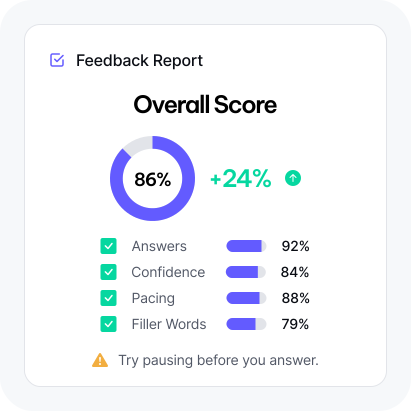
Track access across participant groups, time to useful practice, repeat attempts, adviser escalation, scenario relevance, and transfer into verified job-search actions. Do not collapse these signals into one number. Report reach, direct learning, real-world behaviour, and longer-term outcomes separately so leaders can see where the chain is strong, where participants drop out, and where external conditions limit attribution.
Use a concrete example before expanding the program. Show what information is available, what remains uncertain, which behaviour matters, and where human judgment enters. Participants should be able to explain the purpose in plain language and understand what happens after the interaction. The broader resource on governing AI role-play with employee trust provides additional context for this part of the design.
Evidence should lead to a decision about the process, not a label about the person. Review the result with the relevant humans, document exceptions and missing data, and preserve a route for clarification. That makes improvement possible without pretending the tool can understand the complete career transition context.
Scale gradually across cohorts and regions
Govern the work with career advisers, service designers, accessibility specialists, privacy leaders, and participant panels. Start with a bounded pilot, record assumptions, review cases that did not fit, and change one element at a time. Assign an owner and review date so the process can respond to policy, labour-market, role, accessibility, and product changes.
Use a concrete example before expanding the program. Show what information is available, what remains uncertain, which behaviour matters, and where human judgment enters. Participants should be able to explain the purpose in plain language and understand what happens after the interaction.
Evidence should lead to a decision about the process, not a label about the person. Review the result with the relevant humans, document exceptions and missing data, and preserve a route for clarification. That makes improvement possible without pretending the tool can understand the complete career transition context.
A four-week implementation sequence
Week 1: define the decision and baseline. Document the current workflow, the near-term outcome, the people affected, and the evidence already available. Run one short baseline without extensive coaching. The baseline is not a verdict; it checks whether the scenario, instructions, access, and success criteria reflect the real situation.
Week 2: teach, practise, and retry. Give participants the knowledge, examples, policy, or role context they need before asking them to perform. Complete a focused Resso scenario, review feedback, choose one observable change, and repeat the relevant moment while the reasoning is still fresh.
Week 3: vary context and add human interpretation. Change one feature such as the audience, constraint, question, or level of resistance while keeping the core skill stable. Ask career advisers, service designers, accessibility specialists, privacy leaders, and participant panels to review selected evidence, moderate the criteria, and identify feedback that needs context.
Week 4: test transfer in a real workflow. Connect the practice to a live coaching appointment and the participant's next networking, screening, interview, or negotiation conversation. Collect only the evidence needed to answer whether the preparation helped. Invite the people involved to describe what transferred, what remained difficult, and which support or design change should come next.
After the pilot, keep the workflow only if it adds value beyond current practice. Review results across relevant groups, document accommodations and missing data, confirm that human escalation worked, and record a decision to expand, revise, pause, or remove the process.
Frequently asked questions
Does personalization require a unique scenario for every person?
No. A well-designed library can combine reusable structures with role, stage, and audience choices. Human coaching handles the exceptions and deeper interpretation.
What information should participants enter?
Only information needed for the practice goal. Avoid unnecessary personal, health, employer-confidential, or identifying data.
How can providers control scenario quality?
Assign owners, use review dates, test with advisers and participants, and retire scenarios when labour-market expectations or policies change.
Will scale reduce coach involvement?
It can reduce repetitive setup while making patterns visible. The aim is to redirect coaching time toward strategy, context, wellbeing, and difficult decisions.
Scale the practice while protecting the relationship
Personalization at scale comes from relevant choices, adaptive practice, and timely human interpretation—not from pretending every participant needs a fully unique program. A useful program makes the next real conversation more reachable while keeping uncertainty, dignity, and human judgment visible.
Begin with one bounded use case, one accountable owner, and one measure that reflects the actual purpose. Listen to the people experiencing the process, test transfer, and revise the design when the evidence does not support the promise.

.jpeg)