
Understand the freeze response without turning it into an identity
Replace long scripts with retrieval anchors
Practice pressure progressively instead of jumping to the hardest simulation
Use an in-the-moment reset when your mind goes blank
Train the unpredictable part of the interview
Prepare your body and environment as part of the answer
You may freeze in interviews because pressure narrows attention and makes familiar information harder to retrieve. The solution is not to memorize more. Build a small set of answer anchors, practice under gradually increasing realism, and rehearse a recovery routine for the moment your mind goes blank.
Freezing is not proof that you are unqualified or poor at communication. Interviews combine social evaluation, uncertainty, time pressure, and the need to search memory while speaking. That load can overwhelm a prepared person. The practical ideas below complement general interview preparation by focusing on what happens when your knowledge feels unavailable.
Understand the freeze response without turning it into an identity
A freeze response can feel like blankness, racing thoughts, shallow breathing, a lost sentence, or an urge to answer immediately with anything. The body is responding to perceived stakes. The experience is real, but it is a state, not a permanent description of who you are.
Notice the earliest signal. Some people speed up, stop breathing fully, grip the chair, or look for the perfect opening sentence. Naming the signal creates a decision point. You can pause before the response becomes a spiral. This observation is more useful than criticizing yourself after the interview.
Replace long scripts with retrieval anchors
Prepare a story bank with five or six examples, each reduced to a short title, the problem, your action, and the result. The title might be ‘supplier delay,’ ‘new reporting process,’ or ‘difficult customer handoff.’ These anchors are easier to retrieve than polished paragraphs.
Map each story to several skills. One project may show planning, conflict resolution, learning, and influence. Flexible stories reduce the amount you must remember and make unexpected questions less threatening. The method also supports the natural delivery described in the guide to behavioral interview answers.
Practice pressure progressively instead of jumping to the hardest simulation
Start by answering one question alone with notes. Next, answer without notes. Then add an unfamiliar follow-up, a camera, a time limit, or a realistic interviewer persona. Increase one pressure at a time so your nervous system learns that difficulty can rise without the conversation becoming unsafe.
End each practice session with a successful but not necessarily perfect attempt. If you repeatedly finish while overwhelmed, practice may strengthen dread. Short sessions of 10 to 20 minutes often work better than one exhausting hour. The question is whether you can remain present and retrieve the next anchor.

Use an in-the-moment reset when your mind goes blank
Pause your exhale, place both feet on the floor, and ask for the question to be repeated or clarified. You can say, ‘I want to choose the most relevant example. May I take a moment?’ This is professional behavior, not failure. A thoughtful pause usually feels longer to you than to the interviewer.
Retrieve a story title before trying to form the first sentence. If no example appears, say what you would do in a comparable situation, then acknowledge that it is a hypothetical response. When the answer ends, take one normal breath and treat the next question as a fresh start.
Train the unpredictable part of the interview
Many candidates prepare opening answers but freeze when the interviewer asks ‘What did you do next?’ or ‘What would you change?’ Practice is more effective when the follow-up depends on your answer. That forces retrieval and adjustment rather than recitation.
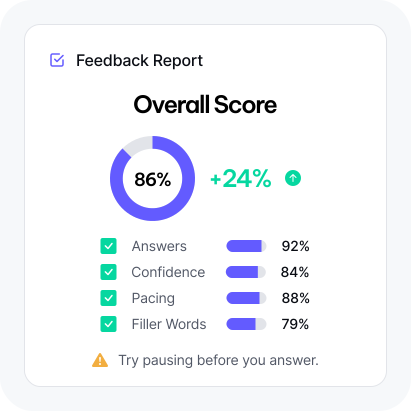
With Resso, create several interviewer styles: warm and conversational, concise and neutral, skeptical but fair, and a panel that takes turns. Ask the system to vary wording and to leave short silences. Review whether you recovered, clarified, and answered the real question, not whether every sentence sounded polished.
Prepare your body and environment as part of the answer
Sleep, food, hydration, medication routines, travel time, clothing comfort, and technical setup can affect access to memory. Build a pre-interview routine that reduces preventable strain. For video interviews, test the camera, microphone, notifications, and room before the day. The guide to remote video interview practice covers that environment in detail.
Avoid cramming until the final minute. Use the last 10 minutes to settle, review only story titles, and remind yourself of the interview's purpose: two sides are gathering evidence about fit. A realistic goal is to be clear and curious, not calm every second.
Know when practice is not the only support you need
If interview anxiety is severe, persistent, connected to trauma, or affecting daily life, consider help from a qualified mental health professional. A career coach can support preparation, but should not present coaching as treatment. You may also be entitled to an accommodation depending on your circumstances and location.
Possible adjustments could include extra processing time, receiving the interview format in advance, breaks, or an accessible communication mode. Decide what would reduce the barrier without changing the essential evaluation. Asking for an appropriate process is not asking to avoid the work.
Common mistakes to avoid
Anxiety often leads candidates to prepare in ways that increase cognitive load. The following habits can look productive while making retrieval and recovery harder.
Writing dozens of full answers: A large script library gives your memory more material to police. Reduce preparation to flexible stories, facts, and opening beats.
Practicing only when calm: A quiet written rehearsal does not teach recovery. Add manageable realism, such as a camera, unfamiliar wording, or a neutral interviewer, after the answer structure is stable.
Starting with maximum pressure: A hostile panel simulation can overwhelm before learning occurs. Increase one difficulty at a time and repeat at a level where you can still use feedback.
Judging visible nerves: A shaky voice or warm face does not mean the answer failed. Review relevance, evidence, and recovery before evaluating appearance or style.
Hiding every pause: Filler words and rushed openings often create more confusion than a brief silence. Practice a deliberate pause as part of professional response behavior.
Practicing until exhausted: Fatigue can be mistaken for inability and weaken the next session. Use a stopping rule, record what to try next, and recover before repeating.
A seven-day practice plan
Day 1: Identify your earliest freeze signals. Day 2: create six story anchors. Day 3: answer five questions alone with permission to pause. Day 4: add one realistic interviewer and one follow-up per answer.
Day 5: rehearse the reset sentence and deliberate pause until they feel ordinary. Day 6: run a short mock interview at moderate pressure and review recovery moments. Day 7: complete one final realistic session, then switch from preparation to rest and routine.
Keep a compact recovery log during the week. For each attempt, note the trigger, the earliest body signal, the reset you used, and whether an answer anchor returned. This is not a scorecard. It helps you identify which conditions and actions reliably restore access to your thinking.
Ask one trusted reviewer to watch only the recovery moments. Candidates often remember a pause as a disaster even when it looked like ordinary thought. External evidence can correct that distorted memory and help you preserve useful behavior instead of rushing to hide it.
At the end of each day, keep three short notes: what felt easier, what evidence still needs work, and the exact next practice action. Do not grade the whole session from your mood immediately afterward. Compare the relevant answer or decision with the day's goal, preserve one strength, and make one change. This record turns preparation into a sequence of usable experiments instead of a search for one perfect performance.
Frequently asked questions
Is it bad to tell the interviewer I am nervous?
A brief acknowledgment can be human, but you do not need to make it the focus. Pause, breathe, and return to the question.
How long can I pause before answering?
A few seconds is normal. If you need longer, say that you are choosing a relevant example. Clear intention makes the silence easier to understand.
Should I memorize answers if I freeze?
Memorizing full answers can increase pressure. Use story titles and speaking beats so you have reliable landmarks without one fragile script.
Can mock interviews make anxiety worse?
They can if difficulty rises too quickly or feedback becomes harsh. Use short, progressive sessions and finish with an achievable attempt.
When should I ask for an accommodation?
Timing depends on the adjustment and local process. Ask early enough for the employer to arrange it, and focus on the barrier and useful adjustment.
Practice recovering, not pretending pressure will disappear
Interview confidence does not require the absence of nerves. It grows when you know how to retrieve an anchor, ask for a moment, answer the next part, and reset. That sequence can be trained under realistic but manageable pressure.
Build fewer, more flexible stories. Increase difficulty gradually. Prepare the environment and seek appropriate support when needed. You are not trying to become a different personality. You are making your real ability easier to access when the stakes rise.