

Inclusion begins with the definition of readiness
Separate job requirements from interview conventions
Give participants control over practice conditions
Interpret automated feedback with care
Practise accommodation and self-advocacy conversations
Measure access and experience alongside outcomes
Improve the environment, not only the participant
Inclusive outplacement helps participants communicate relevant evidence in ways that work for the role while preserving language identity, disability accommodations, and different communication styles. The value appears when the workflow is designed around a real decision and a respectful human experience, not when technology is added to an unclear process.
This guide is for multilingual, neurodivergent, disabled, anxious, and culturally diverse professionals navigating an employment transition. It positions Resso as a structured practice and evidence layer inside a broader system led by qualified people. The platform can make realistic repetition more available, while career advisers retain responsibility for context, support, and every consequential decision.
Inclusion begins with the definition of readiness
Generic coaching can mistake accent, eye contact, speed, expressiveness, or familiarity with local interview conventions for capability. Begin by writing down the decision this part of the process is meant to support. Name the audience, the evidence required, and what must remain outside the scope. That discipline keeps the provider from solving a broad people problem with a narrow communication signal.
Use a concrete example before expanding the program. Show what information is available, what remains uncertain, which behaviour matters, and where human judgment enters. Participants should be able to explain the purpose in plain language and understand what happens after the interaction.
Evidence should lead to a decision about the process, not a label about the person. Review the result with the relevant humans, document exceptions and missing data, and preserve a route for clarification. That makes improvement possible without pretending the tool can understand the complete career transition context.
Separate job requirements from interview conventions
A useful design is a selectable practice environment with clear questions, captions or transcripts where supported, processing time, short segments, alternate audience tones, and the participant's established accommodations. Make the instructions concrete enough that participants know what success requires, but do not prescribe one personality, accent, or polished style. Test whether the same prompt remains understandable when experience, confidence, language, or access conditions change.
Use a concrete example before expanding the program. Show what information is available, what remains uncertain, which behaviour matters, and where human judgment enters. Participants should be able to explain the purpose in plain language and understand what happens after the interaction. The broader resource on Resso's business communication practice environment provides additional context for this part of the design.
Evidence should lead to a decision about the process, not a label about the person. Review the result with the relevant humans, document exceptions and missing data, and preserve a route for clarification. That makes improvement possible without pretending the tool can understand the complete career transition context.
Give participants control over practice conditions
In practice, participants choose the communication goal and support, practise job-relevant content, inspect feedback critically, and decide with an adviser which suggestions improve understanding without erasing identity. Use short loops. A first attempt reveals the current pattern, targeted guidance makes one change visible, and a second attempt tests whether the change improved the response. Repetition should build adaptable judgment rather than a memorized performance.
Use a concrete example before expanding the program. Show what information is available, what remains uncertain, which behaviour matters, and where human judgment enters. Participants should be able to explain the purpose in plain language and understand what happens after the interaction. The broader resource on Resso's custom scenario builder provides additional context for this part of the design.
Evidence should lead to a decision about the process, not a label about the person. Review the result with the relevant humans, document exceptions and missing data, and preserve a route for clarification. That makes improvement possible without pretending the tool can understand the complete career transition context.

Interpret automated feedback with care
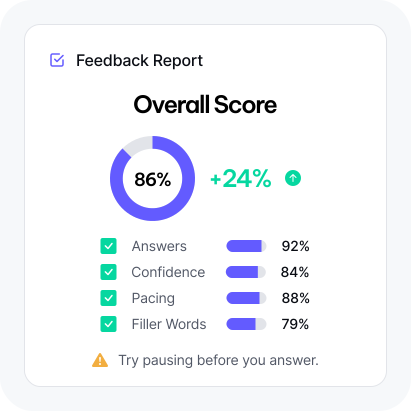
Do not infer disability, language proficiency, confidence, honesty, or job fit from automated delivery signals. Provide alternatives, human review, and a way to reject inappropriate feedback. People need notice, realistic choices, accessibility, privacy boundaries, and a clear route to qualified human support. Automated feedback can organize observations, but career advisers remain responsible for interpreting context and protecting consequential decisions.
Use a concrete example before expanding the program. Show what information is available, what remains uncertain, which behaviour matters, and where human judgment enters. Participants should be able to explain the purpose in plain language and understand what happens after the interaction.
Evidence should lead to a decision about the process, not a label about the person. Review the result with the relevant humans, document exceptions and missing data, and preserve a route for clarification. That makes improvement possible without pretending the tool can understand the complete career transition context.
Practise accommodation and self-advocacy conversations
The most important test is transfer into an accessible networking, recruiter, interview, accommodation, or onboarding conversation selected by the participant. Ask what changed when another person, real timing, incomplete information, or actual consequences entered the conversation. Transfer may reveal that the original scenario, instruction, support, or success criterion needs revision.
Use a concrete example before expanding the program. Show what information is available, what remains uncertain, which behaviour matters, and where human judgment enters. Participants should be able to explain the purpose in plain language and understand what happens after the interaction.
Evidence should lead to a decision about the process, not a label about the person. Review the result with the relevant humans, document exceptions and missing data, and preserve a route for clarification. That makes improvement possible without pretending the tool can understand the complete career transition context.
Measure access and experience alongside outcomes
Track access, completion with chosen supports, relevance of examples, self-advocacy, successful accommodation requests, participant experience, and movement into suitable opportunities. Do not collapse these signals into one number. Report reach, direct learning, real-world behaviour, and longer-term outcomes separately so leaders can see where the chain is strong, where participants drop out, and where external conditions limit attribution.
Use a concrete example before expanding the program. Show what information is available, what remains uncertain, which behaviour matters, and where human judgment enters. Participants should be able to explain the purpose in plain language and understand what happens after the interaction. The broader resource on measuring communication readiness responsibly provides additional context for this part of the design.
Evidence should lead to a decision about the process, not a label about the person. Review the result with the relevant humans, document exceptions and missing data, and preserve a route for clarification. That makes improvement possible without pretending the tool can understand the complete career transition context.
Improve the environment, not only the participant
Govern the work with participants, accessibility professionals, multilingual career practitioners, disability-led reviewers, and coaches. Start with a bounded pilot, record assumptions, review cases that did not fit, and change one element at a time. Assign an owner and review date so the process can respond to policy, labour-market, role, accessibility, and product changes.
Use a concrete example before expanding the program. Show what information is available, what remains uncertain, which behaviour matters, and where human judgment enters. Participants should be able to explain the purpose in plain language and understand what happens after the interaction.
Evidence should lead to a decision about the process, not a label about the person. Review the result with the relevant humans, document exceptions and missing data, and preserve a route for clarification. That makes improvement possible without pretending the tool can understand the complete career transition context.
A four-week implementation sequence
Week 1: define the decision and baseline. Document the current workflow, the near-term outcome, the people affected, and the evidence already available. Run one short baseline without extensive coaching. The baseline is not a verdict; it checks whether the scenario, instructions, access, and success criteria reflect the real situation.
Week 2: teach, practise, and retry. Give participants the knowledge, examples, policy, or role context they need before asking them to perform. Complete a focused Resso scenario, review feedback, choose one observable change, and repeat the relevant moment while the reasoning is still fresh.
Week 3: vary context and add human interpretation. Change one feature such as the audience, constraint, question, or level of resistance while keeping the core skill stable. Ask participants, accessibility professionals, multilingual career practitioners, disability-led reviewers, and coaches to review selected evidence, moderate the criteria, and identify feedback that needs context.
Week 4: test transfer in a real workflow. Connect the practice to an accessible networking, recruiter, interview, accommodation, or onboarding conversation selected by the participant. Collect only the evidence needed to answer whether the preparation helped. Invite the people involved to describe what transferred, what remained difficult, and which support or design change should come next.
After the pilot, keep the workflow only if it adds value beyond current practice. Review results across relevant groups, document accommodations and missing data, confirm that human escalation worked, and record a decision to expand, revise, pause, or remove the process.
Frequently asked questions
Should accent reduction be an outplacement goal?
Usually no. Focus on mutual understanding and job-relevant communication. Accent is part of identity and is not evidence of competence.
Can every participant use the same scenario?
The core goal can be shared, but pacing, format, supports, context, and difficulty may need to differ.
What if automated feedback conflicts with an accommodation?
The accommodation and qualified human judgment take priority. Document the issue, allow the participant to disregard the signal, and revise the configuration.
How should providers test accessibility?
Include disabled and multilingual participants in design and testing, support multiple routes through the task, and evaluate the complete service rather than a technical checklist alone.
Readiness should widen opportunity, not narrow identity
Inclusive outplacement helps participants communicate relevant evidence in ways that work for the role while preserving language identity, disability accommodations, and different communication styles. A useful program makes the next real conversation more reachable while keeping uncertainty, dignity, and human judgment visible.
Begin with one bounded use case, one accountable owner, and one measure that reflects the actual purpose. Listen to the people experiencing the process, test transfer, and revise the design when the evidence does not support the promise.
.jpeg)