
Oral literacy makes academic language usable
Choose vocabulary that serves a communication purpose
Build content-grounded Resso scenarios
Scaffold multilingual learners without lowering the thinking demand
Use follow-up questions to reveal understanding
Give feedback on meaning before fluency
Measure oral language growth across attempts
Resso can support oral literacy in K-12 by giving students repeated opportunities to use academic vocabulary while explaining ideas, answering questions, comparing evidence, and repairing misunderstandings. Recognizing a term on a worksheet is different from retrieving it during a conversation and using it accurately enough that another person can follow the reasoning.
Oral practice should not become a test of accent, speed, or one preferred speaking style. Within Resso's education practice environment, teachers can create short, content-rich conversations that make disciplinary language usable while preserving scaffolds for multilingual learners, students with disabilities, and learners who need additional processing time.
Oral literacy makes academic language usable
Academic vocabulary carries relationships, not just definitions. A science student must use cause, variable, evidence, and limitation together. A history student must distinguish source, perspective, context, and interpretation. Speaking reveals whether the learner can connect those ideas or has only memorized separate terms.
Short explanations also strengthen retrieval. When students must choose language without a complete script, they notice which words are available and which remain fragile. The teacher gains evidence about conceptual understanding, while the student gains a reason to revisit a definition, example, or connection before a larger assessment.
Choose vocabulary that serves a communication purpose
Do not ask students to force ten terms into an answer. Select a small set that helps them complete a real task: explain a process, compare solutions, interpret a result, defend a claim, or ask a disciplinary question. The audience and purpose determine which words matter.
A useful Resso prompt might ask a grade 6 learner to explain erosion to a community audience, or a grade 10 learner to defend why a data pattern supports a conclusion. The conversation partner can ask for definitions, examples, and clarification, helping vocabulary function inside reasoning rather than as decoration.
Build content-grounded Resso scenarios
Use the lesson objective, verified source material, and expected misconceptions to shape the scenario. Resso's custom scenario builder can establish the role and challenge, but educators remain responsible for content accuracy and age appropriateness. Do not rely on the simulation to teach facts the class has not learned.
Ask the digital listener to request a plain-language explanation after an academic one. Switching registers helps students understand that precision and accessibility are compatible. A learner who can define a term, use it in context, and explain it without the term usually understands more than a learner who can repeat the glossary sentence.

Scaffold multilingual learners without lowering the thinking demand
Provide a vocabulary bank, sentence openings, captions, a visual reference, or additional planning time while keeping the intellectual task intact. A multilingual student can compare evidence or justify a method even while developing fluency. The scaffold should reduce avoidable language barriers, not reduce the quality of thinking expected.
Let students rehearse more than once and compare which wording made the idea clearer. If appropriate, they can first discuss the concept in a stronger language, then practice the target-language explanation. The article on building a complementary skill stack reinforces why language, subject knowledge, and communication develop together.
Use follow-up questions to reveal understanding
A prepared definition can hide a misconception. Follow-up questions such as 'What would be an example?', 'How is this different?', and 'What changes if this condition changes?' require the learner to use the term flexibly. The response does not need to be polished, but it must remain connected to the content.
Configure the scenario to probe only within the taught material. When an answer is uncertain, students should learn to name the uncertainty and return to a source. Resso feedback can identify clarity or structure, while the teacher checks whether the academic meaning is accurate.
Give feedback on meaning before fluency
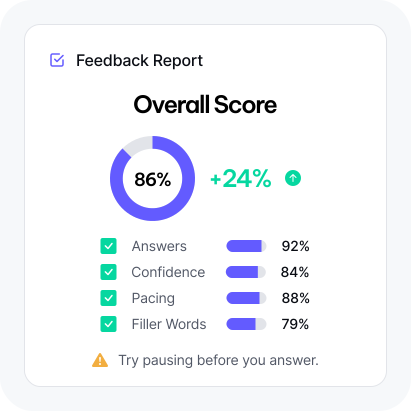
Begin with whether the student answered the question, used the term accurately, and connected it to evidence or an example. Pace, filler words, and sentence-level smoothness may matter later, but fluent delivery cannot compensate for incorrect meaning.
Choose one improvement and repeat the relevant explanation. A student might add the missing relationship between two terms or replace a vague pronoun with the precise concept. This immediate revision turns vocabulary feedback into a change the learner can hear and remember.
Measure oral language growth across attempts
Useful evidence includes accurate term use, quality of explanation, response to follow-up questions, transfer to a new example, and reduced dependence on prompts. Teachers can sample short tasks over time rather than score every conversation. Students can also annotate which term became easier to use and why.
Do not treat accent or similarity to a model voice as proficiency. Compare the learner with their prior attempts and the stated curriculum outcome. When oral practice is combined with reading, writing, and subject instruction, schools gain a fuller picture of whether academic language is becoming usable.
A four-week Resso implementation sequence
Week 1: define the outcome and collect a baseline. Select one near-term goal: using a small set of academic terms to explain, compare, and answer a follow-up. Explain the purpose to learners, show the criteria, confirm privacy and accessibility arrangements, and let each participant complete one short attempt before receiving extensive coaching. The baseline is not a grade or a prediction. It gives the learner and educator a concrete starting point and reveals whether the scenario, instructions, device access, and level of challenge are working as intended.
Week 2: teach, practice, and choose one change. Provide the knowledge, examples, vocabulary, or professional framework students need before asking them to perform. Learners then complete a Resso scenario, review feedback, and select one observable improvement that matters to the audience. They repeat only the relevant moment while it is fresh. This focused retry helps students experience cause and effect instead of treating the feedback report as a final judgment about their ability.
Week 3: vary the context and add human interpretation. Change one feature, such as the question, audience, constraint, or level of follow-up, while keeping the core skill stable. Ask the subject teacher and the student to review a sample, moderate the criteria, and identify feedback that needs context. Students should explain which suggestion they accepted, which they questioned, and what evidence supports that choice. The purpose is adaptable judgment, not compliance with every automated signal.
Week 4: transfer the skill into an authentic setting. Use a current science, mathematics, humanities, arts, or technical learning activity as the next test. Collect only the evidence needed to answer whether practice helped, including more accurate vocabulary use, stronger explanations, and transfer to a new example. Invite students to describe what transferred and what remained difficult. A real setting may expose timing, relationship, access, or content issues that a simulation could not reproduce, so treat transfer evidence as guidance for the next design cycle rather than a verdict on the learner.
After the pilot, keep the scenario only if it adds value beyond existing instruction. Review participation and outcomes by learner group, document accommodations and missing data, and check that students reached human support when needed. Revise one element at a time, record the reason, and set a future review date. This small, transparent cycle produces a more credible implementation than launching many scenarios without knowing which conditions helped students improve.
Frequently asked questions
Is oral literacy only part of language arts?
No. Every subject has language students must use to explain relationships, evidence, procedures, and decisions.
How many vocabulary terms belong in one Resso scenario?
Use a small set that naturally supports the task. Depth and accurate use are usually more valuable than forcing a long word list into one response.
Can Resso correct subject-matter errors?
Educators should verify content. Automated feedback may support communication, but the teacher and approved sources remain responsible for academic accuracy.
Should fluency be graded before meaning?
Meaning, relevance, and accurate use should come first. Fluency feedback should be age-appropriate and interpreted with language development and accommodations in mind.
Vocabulary becomes powerful when students can use it
Academic language is more than a list to remember. It is a set of tools students use to explain, compare, question, and reason with other people. Resso can create the repetitions that make those tools available in the moment.
When teachers ground scenarios in verified content and evaluate meaning before polish, oral practice can deepen subject understanding while expanding the number of students who get to use academic language aloud.