
International students navigate several communication systems at once
Start with academic participation and help-seeking
Practice language in meaningful academic and professional contexts
Prepare for networking, interviews, and workplace conversations
Avoid cultural deficit framing in scenarios and feedback
Connect private practice to people and community
Measure outcomes without blaming students for structural barriers
A four-week Resso implementation sequence
Practice should expand participation without erasing identity
Resso can support international students by providing repeatable practice for seminars, office hours, group work, presentations, networking, interviews, workplace communication, and help-seeking in an unfamiliar education system. The purpose is not to erase accents or train students to imitate one cultural norm. It is to expand their ability to understand expectations, communicate choices, and participate with confidence grounded in practice.
International student success also depends on inclusive teaching, accurate immigration and career guidance, language support, community, finances, and employer access. Resso's education practice environment can strengthen communication within that system, but it cannot replace qualified advisors or fix structural barriers by itself.
International students navigate several communication systems at once
A learner may understand course content while learning new expectations for discussion, citation questions, office hours, group decision-making, or disagreement. The same student may also be preparing for networking and interviews in a labour market with unfamiliar norms and legal constraints.
Programs should avoid interpreting hesitation as lack of knowledge or motivation. Students are often processing language, context, power, and possible consequences simultaneously. Practice can reduce uncertainty by making the purpose and structure of a conversation visible before performance is judged.
Start with academic participation and help-seeking
Useful scenarios include asking an instructor to clarify an assignment, contributing to a seminar, negotiating a group role, discussing feedback, and seeking support after a difficult assessment. These conversations can influence belonging, learning, and persistence early in the student journey.
Use Resso's Discussion practice experience or a custom scenario to vary questions and viewpoints. Faculty should explain local expectations explicitly rather than asking the student to infer unwritten norms from automated feedback.
Practice language in meaningful academic and professional contexts
Vocabulary and grammar become more usable when they serve a purpose. Students can explain a research idea, summarize a meeting, ask for clarification, or present a project recommendation. Repetition helps them retrieve language while listening and deciding what the audience needs.
Allow planning notes, captions, slower pacing, and multiple attempts. Feedback should prioritize meaning, relevance, and response before smoothness. An accent is not an error, and similarity to a single model voice should never become the definition of readiness.

Prepare for networking, interviews, and workplace conversations
International students may need to explain global experience, translate unfamiliar credentials, ask about role expectations, and discuss work authorization with the correct office or employer contact. Practice can help them identify truthful language and questions without offering legal advice.
The guide to building genuine professional relationships can support networking scenarios. Career staff should add local labour-market context, employer access, and referral to authorized immigration professionals for any consequential status question.
Avoid cultural deficit framing in scenarios and feedback
Do not teach one level of directness, eye contact, small talk, or self-promotion as universally professional. Explain which behavior is common in a particular context, why it may help, and what alternatives can still achieve the same outcome. Students can then make informed choices rather than receive an instruction to assimilate.
Review scenarios for stereotypes and unequal power. A digital interviewer should not treat nationality or accent as a problem. Human moderators should examine whether feedback penalizes language development or communication differences unrelated to the task.
Connect private practice to people and community
Resso can prepare a first attempt, but relationships develop with humans. Pair practice with peer mentors, faculty office hours, conversation groups, employer events, alumni, student associations, and community organizations. The learner should have a clear next place to use the skill.
Ask students which conversations remain difficult and what institutional response would help. Their feedback may reveal unclear processes, inaccessible events, limited employer knowledge, or scheduling barriers. Success requires changing the environment as well as preparing the student.
Measure outcomes without blaming students for structural barriers
Direct measures include access, repeated practice, academic participation, quality of questions, language use in context, and transfer to real conversations. Student-reported belonging and confidence can add meaning when they are treated as experiences rather than automated traits.
Institutions may examine retention, graduation, placement, interviews, employment, and job quality, but immigration policy, employer practices, discrimination, language access, and labour-market conditions strongly shape those outcomes. Report Resso's contribution to communication readiness without presenting student adaptation as the solution to every barrier.
A four-week Resso implementation sequence
Week 1: define the outcome and collect a baseline. Select one near-term goal: participating in an academic conversation and preparing a truthful career or help-seeking question. Explain the purpose to learners, show the criteria, confirm privacy and accessibility arrangements, and let each participant complete one short attempt before receiving extensive coaching. The baseline is not a grade or a prediction. It gives the learner and educator a concrete starting point and reveals whether the scenario, instructions, device access, and level of challenge are working as intended.
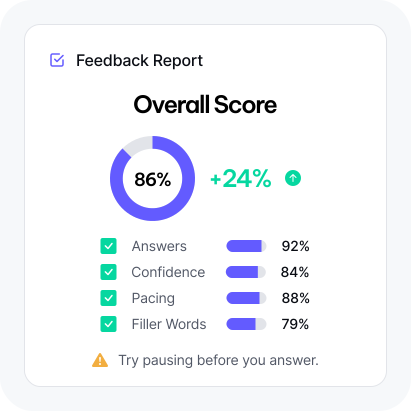
Week 2: teach, practice, and choose one change. Provide the knowledge, examples, vocabulary, or professional framework students need before asking them to perform. Learners then complete a Resso scenario, review feedback, and select one observable improvement that matters to the audience. They repeat only the relevant moment while it is fresh. This focused retry helps students experience cause and effect instead of treating the feedback report as a final judgment about their ability.
Week 3: vary the context and add human interpretation. Change one feature, such as the question, audience, constraint, or level of follow-up, while keeping the core skill stable. Ask the student, relevant faculty or career staff, and international student support professionals to review a sample, moderate the criteria, and identify feedback that needs context. Students should explain which suggestion they accepted, which they questioned, and what evidence supports that choice. The purpose is adaptable judgment, not compliance with every automated signal.
Week 4: transfer the skill into an authentic setting. Use a seminar, office-hours visit, group meeting, career event, interview, or advising appointment as the next test. Collect only the evidence needed to answer whether practice helped, including greater access to participation, useful language in context, successful referrals, and preserved learner identity. Invite students to describe what transferred and what remained difficult. A real setting may expose timing, relationship, access, or content issues that a simulation could not reproduce, so treat transfer evidence as guidance for the next design cycle rather than a verdict on the learner.
After the pilot, keep the scenario only if it adds value beyond existing instruction. Review participation and outcomes by learner group, document accommodations and missing data, and check that students reached human support when needed. Revise one element at a time, record the reason, and set a future review date. This small, transparent cycle produces a more credible implementation than launching many scenarios without knowing which conditions helped students improve.
Frequently asked questions
Should international students try to remove their accents?
No. Focus on meaning, clarity, listening, and audience needs. Accent reduction should not be treated as a universal requirement for academic or career success.
Can Resso provide immigration or work-authorization advice?
No. Students should practice how to ask questions, then obtain answers from authorized institutional or legal professionals.
Is Resso a replacement for language support?
No. It can add contextual speaking practice, while language educators, tutors, peers, and accessible teaching provide essential human support.
How can institutions prevent deficit framing?
Involve international students in design, review feedback for bias, explain contextual norms rather than universal rules, and address institutional barriers alongside student practice.
Practice should expand participation without erasing identity
Resso can help international students make unfamiliar academic and career conversations more predictable, test language in context, and prepare questions before a high-stakes moment. That access can support learning, belonging, and transition.
The institution's responsibility remains substantial. Inclusive teaching, accurate advising, human relationships, and equitable employer access must accompany practice so students can participate as themselves and have their knowledge recognized.