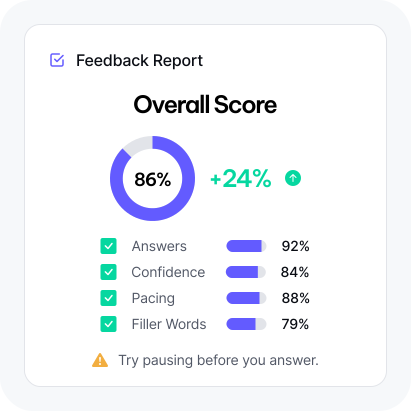


Student communication should not be reduced to one score because effective communication depends on purpose, audience, content, interaction, and growth over time. A single number can hide important differences. A student may be accurate but hard to follow, fluent but unsupported by evidence, thoughtful but hesitant, or strong in a discussion and less prepared for a formal presentation.
A fairer approach uses a small set of transparent criteria, multiple attempts, varied evidence, and educator judgment. The aim is not to avoid assessment. It is to make assessment useful enough to guide improvement and specific enough to describe what the student can do.
Why a single communication score is not enough
Communication is multidimensional. When several dimensions are collapsed into one score, students and educators may not know what the score represents. Two learners can receive the same number for very different reasons and require different next steps.
One score can also create false precision. A small change in pace or filler words may affect an automated rating without changing whether the audience understood the idea. A confident style may appear strong even when the content is inaccurate. A student using a communication device may need more time but communicate with excellent structure and judgment.
Assessment becomes more useful when it describes observable performance. Instead of “communication: 72,” feedback can show that the student used relevant evidence, needs a clearer opening, responded thoughtfully to questions, and improved pacing on the second attempt.
What dimensions of communication can be observed
Content accuracy: Is the information correct and appropriate for the subject?
Purpose and relevance: Does the response address the task, question, or desired outcome?
Organization: Can the listener identify the main point and follow the support?
Evidence and examples: Are claims supported with specific information, experience, reasoning, or sources?
Audience awareness: Does the student explain terms, choose useful detail, and adapt tone or context for the listener?
Listening and response: Does the student acknowledge questions, clarify meaning, and adapt instead of delivering a fixed script?
Delivery for understanding: Do pacing, volume, pauses, visuals, or language choices help the audience follow?
Reflection and growth: Can the student identify a priority, apply feedback, and explain what changed?
Not every task needs every dimension. Assessment should emphasize the behaviors that matter for the learning goal.
How to build a practical rubric
Begin with the communication situation, not a generic list of public-speaking traits. Ask what the student is trying to accomplish and what the audience needs.
1. Define the purpose: Is the student explaining, interviewing, discussing, persuading, advising, collaborating, or presenting?
2. Select a few criteria: Choose three to five dimensions that make success visible for this task.
3. Describe evidence: Use observable language. “States a clear recommendation and supports it with relevant evidence” is more useful than “excellent communicator.”
4. Allow legitimate variation: Do not require one personality, accent, gesture pattern, or conversational style when several can serve the audience.
5. Share the rubric before practice: Students should understand the target and use it for self-review.
6. Test the rubric: Apply it to several sample responses and revise vague, overlapping, or culturally narrow criteria.
The article on self-coaching offers a useful principle for rubrics: observation should lead to a specific action, not only a label.

Why context should change the criteria
Effective communication depends on the situation. A concise emergency briefing, reflective counseling conversation, technical demonstration, job interview, and classroom debate should not reward the same behaviors in the same proportions.
In a science explanation, content accuracy and reasoning may be primary. In a language-learning conversation, successful repair and intelligibility may matter more than perfect grammar. In an interview, relevance, specific examples, and response to follow-up questions may be central. In group discussion, listening and building on others may deserve greater weight.
Context also affects delivery. A fast pace may energize one presentation and make a technical explanation impossible to follow. Direct language may be necessary in one setting and inappropriate in another. The rubric should explain the relationship between behavior and audience rather than presenting personal preferences as universal rules.
Students benefit from comparing contexts. They learn that communication is not a fixed performance but a series of choices shaped by purpose and listener.
How multiple attempts reveal growth
A first attempt shows current readiness under a particular set of conditions. It should not be mistaken for a permanent limit. Multiple attempts reveal whether the student can use feedback, adjust a strategy, and transfer learning.
A practical assessment sequence can include:
Diagnostic attempt: Establish what the student can already do and identify one priority.
Focused practice: Work on a difficult section, question type, or communication behavior.
Second attempt: Apply feedback in a similar situation.
Transfer attempt: Use the same skill with a different audience, question, or constraint.
Reflection: Explain what changed, which strategy helped, and what remains difficult.
This sequence values learning, not only initial polish. It also produces richer evidence for students who need time, language support, or familiarity before their knowledge becomes visible.
How to combine self, peer, teacher, and automated feedback
Each source sees a different part of communication.
Self-assessment: The student knows their intention, preparation, and perceived difficulty. Self-review builds awareness but may miss how the response affected the listener.
Peer feedback: A peer can report what was understandable, memorable, or confusing. Peers need narrow criteria and respectful feedback routines.
Teacher feedback: Educators provide disciplinary knowledge, context, accommodations, and professional judgment. Their time is best used for interpretation and important decisions.
Automated feedback: Technology can provide immediate low-stakes observations about structure, pacing, repeated language, or response content. It can increase practice capacity but may miss nuance or reproduce bias.
Triangulation is stronger than dependence on one source. When feedback conflicts, students and educators can examine the evidence. The article on mentorship and coaching explains why human interpretation remains valuable when a learner must make sense of feedback.
How to use communication data responsibly
Communication practice may produce recordings, transcripts, scores, comments, timestamps, or engagement data. Schools should collect only what supports a defined educational purpose.
Students and families should understand what is collected, why it is needed, who can access it, where it is stored, how long it is retained, and how to request correction or deletion when applicable. Practice data should not quietly become a permanent profile.
Automated indicators require special care. A filler-word count, pace estimate, sentiment label, or confidence score is not a direct measure of intelligence, character, employability, or future success. Use such signals to prompt reflection, not to make high-stakes decisions.
Review results across learner groups. If feedback is less accurate for particular accents, languages, disabilities, devices, or communication styles, educators need a process to identify and address the problem.
The guide to equity and equality reinforces the need to examine whether a seemingly uniform system produces fair access and interpretation.
Frequently asked questions
Should confidence be part of a communication grade?
Use caution. Confidence can be described as self-report or observed willingness to engage, but it should not replace accuracy, reasoning, clarity, or listening. Quiet or nervous students can communicate effectively.
Are filler words a useful assessment criterion?
Only when they materially affect understanding. Occasional filler words are normal. A count should not become a major score without context.
How many rubric criteria are practical?
Three to five criteria are usually enough for one task. More can overwhelm students, increase scoring inconsistency, and reduce the chance that feedback guides action.
Can automated scores be included in final assessment?
They should not be the sole or decisive evidence. Any use should be transparent, validated for the context, reviewed by educators, and accompanied by appropriate alternatives and a way to challenge errors.
How can teachers assess growth fairly?
Use comparable but not identical tasks, the same transparent criteria, evidence from more than one attempt, and student reflection about what changed.
Assessment should make growth visible
The purpose of communication assessment is not to compress a complex learner into one number. It is to describe what the student can do, identify a useful next step, and show how performance changes with practice.
Clear criteria, context, multiple attempts, varied feedback, and responsible data use create a richer and fairer picture. A score may still have a place, but it should be the summary of evidence, not a substitute for understanding it.