
Research what the interview is designed to learn
Clarify your motivation beyond prestige or a generic desire to help
Build a balanced bank of truthful examples
Practice explaining program fit as a two-way match
Handle ethical and situational questions with transparent reasoning
Practice reflection without turning every weakness into a disguised strength
Review Resso feedback without optimizing away your identity
A one-week Resso plan before the interview
Prepare to be understood, not to become an imaginary ideal applicant
Use Resso for scholarship or university admission interviews by building a scenario from the program and selection criteria, practicing truthful examples, answering follow-up questions, and refining how you connect your past choices with the opportunity ahead. The benefit is not discovering a secret answer. It is learning to communicate your real motivation and judgment under pressure.
Admission and scholarship interviews vary widely. Some assess program fit, service, leadership, research interest, ethics, or readiness for a professional pathway. Resso's education practice experience can create a realistic rehearsal, but the official program information and your own experience must ground every answer.
Research what the interview is designed to learn
Read the official program or scholarship page, invitation, published criteria, and format instructions. Identify the values and capabilities the selection process names. Do not rely on anonymous lists that claim to reveal exact questions.
Use Resso's Mock Interview experience to create a representative conversation. Include the program, interview type, length, your educational stage, and the public criteria. Ask for a mix of motivation, experience, situational, and reflective questions.
If the interview uses multiple stations, a panel, recorded responses, or a portfolio discussion, reflect that format. Practice timing and transitions, but do not assume the AI knows private scoring rules or current questions.
Clarify your motivation beyond prestige or a generic desire to help
Explain what experiences led you toward the field, what you have learned about the work, what questions still interest you, and why this specific opportunity supports the next stage. Motivation becomes credible when it connects choices and evidence rather than praise for the institution.
Practice a two-minute version, then ask the Resso avatar to probe each claim. If you say you value research, which experience exposed you to it? If you want community impact, what have you already done and what did it teach you about limits or responsibility?
Avoid constructing a dramatic origin story because you think one is expected. Ordinary sustained choices—coursework, caregiving, work, service, curiosity, or recovery from a setback—can reveal more than a polished narrative that is not true.
Build a balanced bank of truthful examples
Prepare examples for collaboration, leadership, learning, challenge, service, ethical judgment, and receiving feedback. Include outcomes, but also what changed in your thinking. Selection committees often want evidence of reflection, not only a list of achievements.
Use examples from school, work, family, community, clubs, research, arts, athletics, and independent projects when relevant. Be precise about your role. Credit others and explain the constraints. A smaller example with honest detail can be stronger than an inflated leadership claim.
The guide to answering behavioural questions naturally provides a flexible evidence structure without requiring you to memorize a script.

Practice explaining program fit as a two-way match
Program fit is not a request to flatter. Identify specific curriculum, learning model, community, research, placement, or support features that connect to your goals. Then explain what you bring through preparation, perspective, habits, and contribution.
Ask the Resso avatar to challenge a vague answer with “Why here rather than another strong program?” Respond with public, verified details and a personal connection. Do not invent relationships with faculty or opportunities you have not researched.
Also evaluate your fit with the program. Prepare questions about teaching, advising, placement support, accessibility, student experience, research pathways, or expectations that matter to your decision.
Handle ethical and situational questions with transparent reasoning
Some interviews present a conflict, limited resource, professional boundary, or ambiguous team problem. Do not race to the most impressive answer. Identify stakeholders, missing information, relevant duties, possible harms, and a proportionate next step.
Use Resso to vary the scenario after your response. Ask what happens if a key fact changes or a stakeholder disagrees. This tests whether your reasoning is adaptable and whether you can recognize uncertainty.
Do not claim expertise you do not have. For health, legal, safety, or professional situations, acknowledge scope and appropriate escalation. Ethical judgment often includes knowing when to consult policy or a qualified person.
Practice reflection without turning every weakness into a disguised strength
Choose a genuine challenge, setback, or feedback experience that you can discuss responsibly. Explain the context, your part, what you changed, and the evidence that the learning continued. Avoid blaming others or claiming a complete transformation from one event.
Configure follow-ups that ask what you would do differently, what remains difficult, and how you know improvement occurred. Honest limits can make reflection more credible. The committee is meeting a developing student, not a finished product.
Protect private information about other people. Change identifying details and focus on your decisions. Do not disclose health, trauma, or family information beyond what you freely choose and what is relevant.
Review Resso feedback without optimizing away your identity
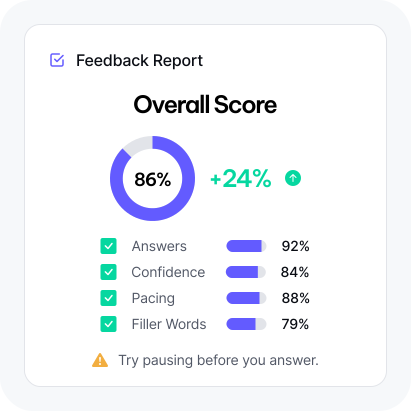
Begin with relevance and evidence. Did you answer the question, support the answer, and show reflection? Next, review clarity, pacing, and length. Choose one answer to repeat with a specific change.
Do not equate one score with admission chances. An AI system does not know the complete applicant pool, committee judgment, institutional priorities, or accommodations. It can help you practice selected communication behaviours, not predict the decision.
Keep your natural voice, accent, and values. If feedback encourages generic certainty or language you would never use, reject it. Ask a counsellor, teacher, advisor, or trusted reviewer for context on high-stakes answers.
Review whether your answers contain the same example too often. Repetition can make a genuine achievement sound like the only evidence you have. Build enough range to show academic preparation, community or work experience, collaboration, and reflection while choosing only the example that actually fits each question.
A one-week Resso plan before the interview
Day 1: research official criteria and build the scenario.
Day 2: clarify motivation and program fit.
Day 3: practice examples and follow-ups.
Day 4: work through ethical or situational questions relevant to the pathway.
Day 5: complete a full mock interview.
Day 6: get human feedback on the most important answers and verify program details.
Day 7: run a short warm-up, prepare logistics and questions, and rest.
If the timeline is shorter, preserve the order: ground in official information, choose truthful evidence, practice aloud, review, and prepare the real format. Do not compensate for limited time by repeating until your answers sound recited.
Prepare the environment as carefully as the content. Confirm the time zone, identification, platform or location, accessibility arrangements, permitted notes, and what to do if technology fails. For a recorded response, practice beginning after a countdown and finishing within the limit without rushing the final idea.
Finally, decide what you need immediately before the interview: a brief example review, a glass of water, a short breathing routine, or silence. Avoid comparing last-minute answers with other applicants online. Your final preparation should preserve attention for listening and thinking.
Frequently asked questions
Can Resso tell me which questions will be asked?
No. It can generate representative practice based on public criteria. Prepare adaptable reasoning and truthful examples rather than memorized predictions.
Should I upload my application essays?
Only if policies and privacy terms allow. A summary of your key themes may be sufficient. Keep sensitive personal information out when it is not needed.
Can Resso predict whether I will receive the scholarship or admission offer?
No. It does not know the full selection context. Use it for communication practice, not outcome prediction.
What if I do not have a dramatic leadership example?
Use a truthful example where you influenced a result, supported others, took responsibility, or improved a process. Scope matters less than clear evidence and reflection.
How do I avoid sounding rehearsed?
Practice the structure and evidence with different wording and follow-ups. Keep cue points, not paragraphs, and listen to each question before choosing an example.
Prepare to be understood, not to become an imaginary ideal applicant
Resso can help you rehearse the pressure, follow-ups, and reflection that scholarship and admission interviews require. Ground the scenario in official information and use it to make real experience easier to explain.
The interview still belongs to you. Bring honest examples, informed questions, and the willingness to think aloud when certainty is impossible. Practice should make that person clearer—not replace them with a script.