

What is communication readiness?
Begin with the decision the data will support
Define observable criteria that match the situation
Use multiple attempts to measure learning, not one performance
Combine automated observations with human judgment
Include learner reflection and transfer to real work
Watch for bias, gaming, and metric misinterpretation
Build a responsible readiness view for managers
Measure enough to guide growth, not enough to create false certainty
Communication readiness should be measured through several forms of evidence: performance in relevant scenarios, improvement across attempts, learner reflection, qualified human observation, and transfer into real work. A single score may summarize part of that picture, but it should not be treated as a complete judgment of confidence, character, potential, or job value.
The first question is not “What can the system score?” It is “What decision are we trying to make?” A manager deciding which conversation to coach needs different evidence from a learning team evaluating a program. Clear purpose prevents attractive metrics from becoming inappropriate conclusions.
What is communication readiness?
Communication readiness is the demonstrated ability to handle a defined communication situation at an appropriate level of quality and support. It is always contextual. A person may be ready to explain a routine process and not yet ready to lead a regulatory escalation or a board presentation.
Readiness combines knowledge, retrieval, listening, judgment, clarity, adaptation, and the ability to seek help. It is not the same as extroversion, charisma, or lack of anxiety. A person can feel nervous and still perform responsibly.
The argument in why businesses need communication practice leads naturally to measurement: if skill develops through performance, evidence should include performance rather than only course completion or self-reported confidence.
Begin with the decision the data will support
Name the user of the evidence and the action they may take. An employee may use feedback to choose a next practice goal. A manager may decide whether to observe a live interaction. A learning team may revise a scenario. An organization may evaluate whether a pilot should expand.
Do not collect data merely because it is available. Voice, video, transcripts, timing, scores, and interaction logs can create privacy and governance obligations. If a measure does not support a defined learning or operational decision, remove it.
Consequential decisions require stronger validation, transparency, accommodations, and review. A formative score used privately for practice is not automatically appropriate for promotion, discipline, selection, or compensation.
Define observable criteria that match the situation
Criteria should describe behaviors or outcomes a reviewer can identify. “Executive presence” is too broad and culturally loaded. “States the decision request within the opening, answers the question directly, and distinguishes evidence from assumptions” is more observable.
Use a small set of criteria for each scenario. Accuracy, listening, clarity, relevance, boundary-setting, and next-step quality may matter, but not every dimension deserves equal weight in every conversation. A safety escalation should prioritize correct action over polish.
Describe quality levels with examples. What does an early attempt look like? What is sufficient for routine work? What would strong performance include? Examples improve calibration and make feedback more usable.

Use multiple attempts to measure learning, not one performance
A single attempt is sensitive to fatigue, unfamiliarity, technical problems, anxiety, and the particular scenario. Multiple attempts show whether the learner can use feedback, stabilize a behavior, and respond to variation.
Track movement on the same criteria rather than demanding a higher total score each time. A learner may improve listening while testing a more difficult scenario, so the overall number remains stable. The richer story is that capability increased under greater complexity.
Do not encourage endless retakes for a perfect score. Set a learning goal, allow useful repetition, and move to a different context when the skill is stable. Over-optimization can produce scripted behavior and anxiety rather than transfer.
Combine automated observations with human judgment
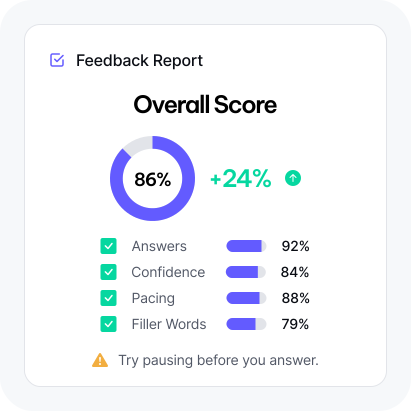
Automated tools can help identify patterns such as talk balance, question use, pace, required content, or changes across attempts. They can provide immediate feedback at a scale that managers cannot match.
Human reviewers remain essential for context, nuance, fairness, and consequences. They can recognize when the scenario was flawed, the employee used a culturally appropriate style, the system misheard an accent, or the right response was to stop the conversation.
Make the division of responsibility explicit. Automated feedback can support rehearsal. Managers interpret work relevance. Learning teams validate criteria and monitor quality. HR, legal, privacy, and employee representatives may need to review consequential uses.
The article on ethical workplace decisions provides useful principles for accountability when a metric appears objective but still depends on human choices about design and use.
Include learner reflection and transfer to real work
Ask the learner what changed, what still feels difficult, and which feedback they plan to use. Reflection reveals whether the person understands the skill rather than merely chasing the score.
Look for transfer with proportionate evidence. A manager might observe a selected call, review a customer handoff, or ask how the employee handled a relevant meeting. Operational data can help, but many factors beyond communication influence sales, resolution time, or project outcomes.
A development plan connects practice to the next work opportunity. The guide to building a personal development plan that sticks shows how specific actions and review points make growth more visible.
Watch for bias, gaming, and metric misinterpretation
Review performance across accents, languages, disabilities, devices, communication modes, roles, and locations. Large differences require investigation. They do not prove either learner weakness or system bias on their own.
Employees will adapt to what is measured. If the system rewards a question count, people may ask unnecessary questions. If it rewards a narrow pace, people may sound unnatural. If leaders display rankings, employees may avoid difficult practice or choose easy scenarios.
Write interpretation rules. State what a measure can support, what it cannot prove, and when human review is required. Train managers to avoid comparisons across different scenario difficulty or case mix.
Build a responsible readiness view for managers
A useful manager view answers practical questions: Who has had an opportunity to practice? Which scenarios are complete? Where are repeated difficulties appearing? Who requested coaching? Are teams improving across comparable attempts?
Show context alongside trends. Include scenario name, difficulty, attempt count, date, and relevant feedback. Avoid a single leaderboard. Protect access based on role and retain data only as long as needed.
Give employees visibility into their own evidence and a way to report inaccurate transcripts or feedback. Trust improves when people understand how a conclusion was formed and can correct material errors.
Design the view around questions, not decoration. A manager may need to know whether an employee has practiced a required scenario, where progress has stalled, and what coaching the learner requested. They rarely need every raw data point on the first screen. Progressive detail reduces the risk of overinterpreting a number without context.
Include notes about data freshness and comparability. A result from an old scenario version should not sit beside a current result as if conditions were identical. If the scoring model or criteria change, preserve the version and avoid drawing a continuous trend across incompatible measures.
Periodically interview managers and employees about how they use the dashboard. If people are choosing easier scenarios, delaying practice, or treating scores as status, the measurement design is shaping behavior in an unintended way. Adjust the display, incentives, or access instead of blaming users for responding to the system.
Frequently asked questions
Can communication readiness be expressed as one score?
A score can summarize defined criteria in one scenario, but it should not represent the whole person or every communication context.
Should managers see every practice transcript?
Not by default. Access should match the learning purpose, privacy notice, and organizational policy. Aggregate patterns or learner-selected moments may be enough.
How often should criteria be recalibrated?
Review them when scenarios, products, policies, roles, or tools change, and whenever reviewer agreement or fairness checks reveal a problem.
What if practice scores improve but work outcomes do not?
Investigate scenario relevance, opportunity to use the skill, operational barriers, manager support, and whether the work outcome is influenced by other factors.
Can readiness data be used for employment decisions?
Only with careful validation, transparency, appropriate legal and HR review, accommodations, and a human process. Formative practice data should not quietly become a high-stakes assessment.
Measure enough to guide growth, not enough to create false certainty
Communication data is useful when it helps an employee choose a next step, a manager coach a real need, or a learning team improve the practice system. It becomes harmful when a convenient score is asked to prove more than it can.
Define the decision, use observable criteria, collect multiple attempts, combine automated and human evidence, and look for transfer. Monitor fairness and give employees visibility and recourse. Responsible measurement does not eliminate judgment. It makes the basis and limits of judgment clearer.
.jpeg)
.png)