

What does the interviewer want from this question?
Build a three-part answer: relevant past, present value, future direction
Choose one career thread instead of listing every role
Write speaking beats, not a word-for-word script
Create versions for different roles and interview stages
Practice with realistic follow-up questions
The best answer to ‘Tell me about yourself’ is a short career story that explains what you do well, how you developed that value, and why this opportunity makes sense now. It is not your autobiography and it is not a spoken copy of your resume. Aim for 60 to 90 seconds, choose two or three relevant points, and finish with a forward-looking connection to the role.
This question feels broad, which is exactly why candidates often freeze or ramble. The interviewer is watching how you organize information before they know which follow-up to ask. A clear opening gives the rest of the interview a useful map. The broader interview preparation guide can help with the rest of the conversation, but this opening deserves its own deliberate practice.
What does the interviewer want from this question?
The interviewer wants a relevant orientation, not every chapter of your life. They are listening for a professional identity, evidence that supports it, and a reason for your interest. They may also be checking whether your explanation matches the resume and whether you can decide what matters for this audience.
Treat the question as an invitation to frame the conversation. If you are a project coordinator moving into customer success, you might emphasize cross-functional communication, calm issue resolution, and the moment you discovered that client-facing work was your strongest contribution. Those details create helpful paths for follow-up questions.
Build a three-part answer: relevant past, present value, future direction
Start with the professional thread that matters most. Then give one or two examples of how that thread developed. Close by connecting it to the role. This past-present-future structure is simple enough to retrieve under pressure and flexible enough to adapt for different employers.
The past should explain, the present should establish value, and the future should show intention. A career changer can spend slightly more time on the bridge. A recent graduate can use projects, placements, volunteering, or part-time work. An experienced candidate can compress early roles and focus on the pattern that led to current expertise.
Choose one career thread instead of listing every role
Review the job description and circle the two capabilities that appear most central. Look across your experience for the thread that connects them. It might be translating complex information, restoring trust with customers, turning ambiguous goals into plans, or helping teams make decisions with evidence.
A thread makes a varied background feel intentional without pretending every move was planned. This is especially useful when you have changed industries or held several short roles. The guide to rewriting a resume for a career change uses the same principle: relevance comes from the connection you explain, not from hiding difference.

Write speaking beats, not a word-for-word script
Write three cue lines, one for each part of the answer. Under each cue, add a fact, example, or result you do not want to forget. Then put the page away and speak from the cues. Your wording should change slightly between attempts while the meaning stays stable.
Word-for-word memorization often produces two problems. You may sound detached because attention shifts to recall, or you may panic when one sentence disappears. Speaking beats create reliable landmarks. They also leave enough mental space to notice the interviewer and adjust your level of detail.
Create versions for different roles and interview stages
A recruiter screen usually needs a compact overview. A hiring manager may value more technical or operational detail. A final panel may already know the basics and want the strategic thread. Build a 30-second, 60-second, and 90-second version rather than forcing one answer into every setting.
Change the emphasis, not the truth. If one role prioritizes stakeholder management and another prioritizes analysis, choose examples that make the relevant value easier to see. Your underlying identity should remain consistent across the application, online profile, and conversation. That consistency also strengthens the ideas in treating LinkedIn as a professional landing page.
Practice with realistic follow-up questions
A useful practice partner should interrupt politely, ask what a vague phrase means, and request evidence. If you say you are ‘results driven,’ the next question should be ‘Which result are you most proud of?’ If you mention a pivot, expect ‘Why did you make that change?’ The goal is not to trap you. It is to make the story sturdier.
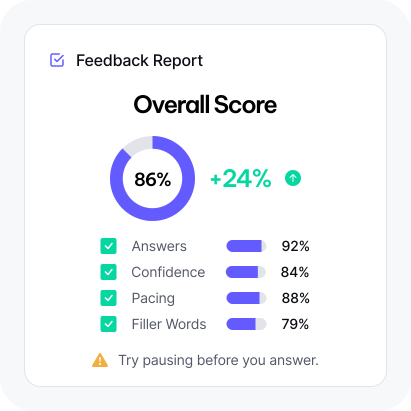
On Resso, create an interviewer for the role, give it the job description and the parts of your background you want tested, then run several short openings. Review whether the feedback points to clarity, relevance, and specificity. Repeat the introduction after each adjustment instead of completing a full interview every time.
Sound natural without becoming vague or too casual
Natural delivery still has structure. Use ordinary words, complete thoughts, and a pace that allows the interviewer to follow. Remove inflated phrases you would never use in conversation. Keep private history private unless it is necessary to understand your professional decision.
End cleanly. A sentence such as ‘That combination is why this customer operations role caught my attention’ signals that the overview is complete. You do not need to ask whether that was enough. A confident stopping point gives the interviewer room to choose the next question.
Common mistakes to avoid
The most common problems come from trying to control the impression instead of helping the interviewer understand your professional direction. Watch for these patterns during recordings and mock interviews.
Beginning with childhood: Personal history can be meaningful, but the interviewer needs professional orientation first. Begin where the relevant career thread becomes visible and add personal context only when it explains a real decision.
Walking through every job: A chronological resume reading forces the interviewer to find the point. Compress less relevant roles and spend time on the experiences that explain current value.
Using labels without evidence: Words such as strategic, collaborative, and passionate do little alone. Attach one compact fact or example that lets the interviewer see the quality in action.
Ending in the past: An answer that stops with your current title can feel incomplete. Name why this role, problem, or environment is the logical next application of your experience.
Editing while speaking: Restarting every imperfect sentence makes the delivery less clear. Complete the thought, pause, and move to the next beat. Conversation tolerates ordinary wording.
Ignoring the job description: A polished generic answer still creates work for the listener. Revisit the employer's priorities and change emphasis so relevance is apparent without exaggeration.
A seven-day practice plan
Day 1: Mark the two most important needs in the job description and choose one career thread that connects them to your experience.
Day 2: Draft three speaking beats and one supporting fact for each.
Day 3: Record three 90-second attempts without reading.
Day 4: Listen once for relevance and once for pace, then remove details that do not help the employer understand your fit.
Day 5: Practice recruiter, hiring-manager, and panel versions.
Day 6: Invite skeptical but fair follow-ups in an AI mock interview.
Day 7: complete two final attempts and stop editing unless the role changes.
At the end of each day, keep three short notes: what felt easier, what evidence still needs work, and the exact next practice action. Do not grade the whole session from your mood immediately afterward. Compare the relevant answer or decision with the day's goal, preserve one strength, and make one change. This record turns preparation into a sequence of usable experiments instead of a search for one perfect performance.
Frequently asked questions
Should I start with where I was born or went to school?
Usually no. Start with the professional point most relevant to the role. Education can appear early for a recent graduate or when a specialized credential matters.
How long should the answer be?
Most answers work well at 60 to 90 seconds. A recruiter may need less. Stop when the interviewer has a useful map, not when every experience has been mentioned.
Can I mention a personal interest?
Yes, if it adds a relevant human detail and does not replace professional evidence. One sentence near the end is often enough.
What if I am changing careers?
Name the transferable thread, give evidence from your previous field, and explain why the new role is a deliberate next application of that value.
Should every version be identical?
No. Keep the facts consistent while changing length and emphasis for the audience. Flexible consistency sounds more credible than memorized sameness.
Give the interviewer a map, not your entire archive
A strong self-introduction makes the rest of the interview easier. Choose one relevant thread, support it with specific evidence, and connect it to the opportunity ahead. Practice from speaking beats until the structure is dependable and the wording remains alive.
The goal is not to perform a flawless paragraph. It is to help another person quickly understand what you bring and where to ask next. When your opening creates that clarity, it has done its job.