
Family partnership is a professional practice
Design authentic but fictional family scenarios
Explain learning with evidence and plain language
Listen to concerns without becoming defensive
Practice collaborative next steps and follow-up
Prepare for language, disability, and access needs
Assess practice through reflection and supervised transfer
A four-week Resso implementation sequence
Family partnership becomes stronger when future teachers can listen and explain
Teacher education programs can use Resso to help candidates practice family and caregiver conversations about learning, assessment, behavior, attendance, accommodations, identity, and support. These conversations require more than correct policy language. Future teachers must listen, explain evidence, avoid defensiveness, respect family knowledge, and identify a useful next step.
Resso adds repeatable rehearsal within its education practice environment, but it cannot represent every family or replace school mentors, community engagement, supervised placements, and direct relationship building. Scenarios should use fictional details and be reviewed for cultural responsiveness, accessibility, and local policy.
Family partnership is a professional practice
Candidates often prepare extensively for instruction but receive fewer chances to rehearse the conversation around instruction. They may need to explain why a student is struggling, respond to a concern about fairness, discuss a change in behavior, or communicate progress without reducing the learner to a grade.
A strong family conversation recognizes that caregivers hold knowledge the teacher does not. The candidate needs to ask, listen, check understanding, and co-create a next step. Practice can make that reciprocal stance more available when the real discussion feels emotionally charged.
Design authentic but fictional family scenarios
Build composite cases that reflect common instructional situations without reproducing a real student's record. Define the learning goal, available evidence, family concern, relevant school process, and what the candidate is authorized to say. Avoid stereotypes that associate particular identities with conflict or disengagement.
Use Resso's custom scenario builder to vary caregiver questions and tone. Faculty should review every scenario for accuracy, bias, and developmental context. The practice partner can prompt reflection, but program staff determine professional expectations.
Explain learning with evidence and plain language
Candidates should practice describing the learning goal, what classroom evidence shows, which support has been tried, and where uncertainty remains. Labels such as lazy, unmotivated, or difficult obscure the instructional information a family needs and can damage trust.
The digital caregiver can ask what a rubric means, why an assessment was used, or how school observations connect to work at home. The candidate then translates educational language without speaking down to the listener or overstating what one data point proves.
Listen to concerns without becoming defensive
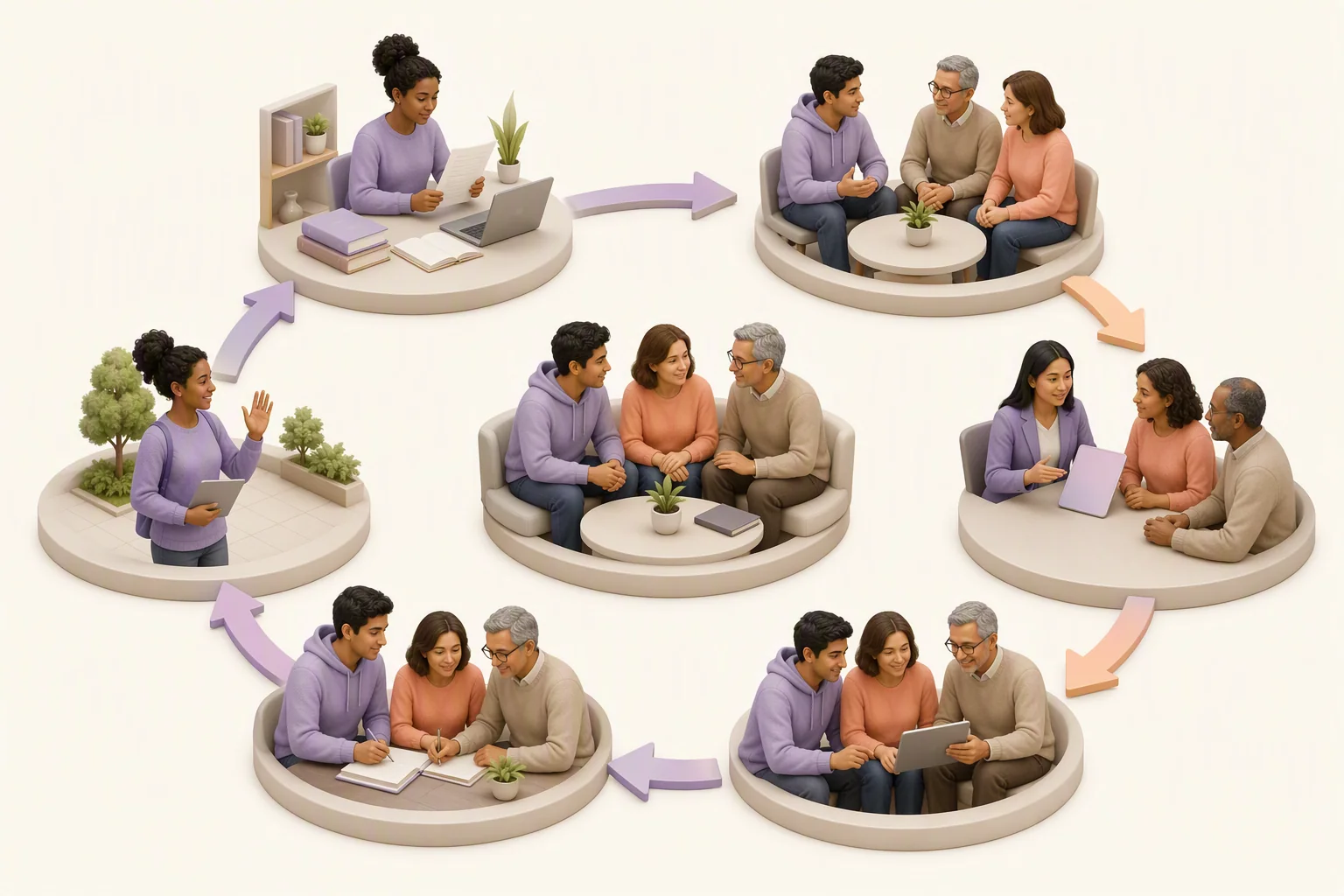
A caregiver may question a decision, describe a different experience, or express frustration with the school. The candidate can practice acknowledging the concern, asking for detail, summarizing accurately, and separating an explanation from an excuse. Listening does not require agreement with every claim.
The article on navigating difficult conversations offers a useful general structure. Teacher education programs should add expectations for confidentiality, mandated reporting, translation access, documentation, and escalation to a mentor or administrator.
Practice collaborative next steps and follow-up
End the conversation with a specific, shared plan: what the teacher will try, what information the family will provide if they choose, what the student will know, when progress will be reviewed, and who to contact. Avoid assigning the family a solution that ignores time, language, disability, or access constraints.
Resso can ask the candidate to summarize the plan and check whether it is acceptable to the caregiver. That final check often reveals assumptions. A respectful follow-up communicates that the relationship continues beyond one difficult meeting.
Prepare for language, disability, and access needs
Teacher candidates should know how to request qualified interpretation, provide accessible information, and avoid using children as interpreters. A simulation can help them slow down, use clear sentences, and direct attention to the family member rather than the interpreter.
Scenarios should also include families who communicate in different ways, work irregular hours, or have prior reasons to distrust institutions. The aim is not to train candidates to manage difference. It is to help them communicate accessibly and recognize when the school must change its approach.
Assess practice through reflection and supervised transfer
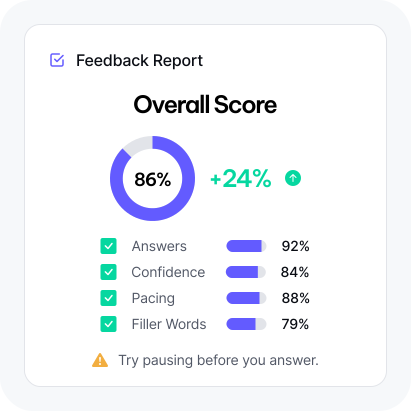
Evaluate evidence use, listening, plain language, avoidance of assumptions, collaborative planning, and appropriate referral. Ask candidates to explain which feedback they used and where automated feedback did not capture cultural or relational nuance.
Then observe transfer in role-play with peers, standardized family participants, or supervised placement conversations when appropriate. Program outcomes may include readiness, mentor feedback, fewer communication breakdowns, and employment preparation, but licensure and professional competence remain human institutional decisions.
A four-week Resso implementation sequence
Week 1: define the outcome and collect a baseline. Select one near-term goal: explaining learning evidence, listening to a caregiver concern, and agreeing on a shared next step. Explain the purpose to learners, show the criteria, confirm privacy and accessibility arrangements, and let each participant complete one short attempt before receiving extensive coaching. The baseline is not a grade or a prediction. It gives the learner and educator a concrete starting point and reveals whether the scenario, instructions, device access, and level of challenge are working as intended.
Week 2: teach, practice, and choose one change. Provide the knowledge, examples, vocabulary, or professional framework students need before asking them to perform. Learners then complete a Resso scenario, review feedback, and select one observable improvement that matters to the audience. They repeat only the relevant moment while it is fresh. This focused retry helps students experience cause and effect instead of treating the feedback report as a final judgment about their ability.
Week 3: vary the context and add human interpretation. Change one feature, such as the question, audience, constraint, or level of follow-up, while keeping the core skill stable. Ask teacher educators, mentor teachers, and community-informed reviewers to review a sample, moderate the criteria, and identify feedback that needs context. Students should explain which suggestion they accepted, which they questioned, and what evidence supports that choice. The purpose is adaptable judgment, not compliance with every automated signal.
Week 4: transfer the skill into an authentic setting. Use a peer role-play, standardized family interaction, or appropriately supervised placement conversation as the next test. Collect only the evidence needed to answer whether practice helped, including clearer evidence use, less defensive listening, and more collaborative follow-up plans. Invite students to describe what transferred and what remained difficult. A real setting may expose timing, relationship, access, or content issues that a simulation could not reproduce, so treat transfer evidence as guidance for the next design cycle rather than a verdict on the learner.
After the pilot, keep the scenario only if it adds value beyond existing instruction. Review participation and outcomes by learner group, document accommodations and missing data, and check that students reached human support when needed. Revise one element at a time, record the reason, and set a future review date. This small, transparent cycle produces a more credible implementation than launching many scenarios without knowing which conditions helped students improve.
Frequently asked questions
Can real student records be used in Resso scenarios?
Use fictional or fully authorized de-identified material only. Programs must follow privacy law, school agreements, and institutional policy.
Can AI represent every family perspective?
No. It can provide structured variation, but community partnership and real human voices are necessary to avoid stereotypes and build cultural responsiveness.
Should candidates practice highly escalated meetings?
Begin with bounded instructional concerns. Complex safety, legal, or traumatic cases require careful faculty design, supervision, and debriefing.
Can Resso assess teaching readiness?
It can provide formative evidence about a defined conversation. Programs must use multiple measures and qualified human judgment for consequential assessment.
Family partnership becomes stronger when future teachers can listen and explain
Teacher candidates deserve practice before their first difficult family meeting. Resso can make the language of evidence, empathy, clarification, and collaborative planning more familiar while there is still room to pause and try again.
The real standard is relational and professional, not technological. When faculty connect simulation to community knowledge, policy, supervised practice, and reflection, future teachers are better prepared to build trust around student learning.