
Start with the real co-op or internship opportunity
Build an evidence bank from student experience
Practice answers as flexible structures, not scripts
Practice follow-up questions that test your evidence
Use Resso feedback to strengthen content and delivery
Prepare questions that help you evaluate the placement
Simulate the actual interview format
Students can use Resso to prepare for a co-op or internship interview by building a scenario from the opportunity, answering questions aloud, reviewing feedback, and repeating the parts that need stronger evidence. The practice is especially useful when you have limited formal work history because it helps you translate school, volunteer, club, caregiving, and project experience into relevant examples.
A real interview should not be the first time you explain what you contributed to a team or why a placement fits your goals. Resso's live AI interview practice can create the pressure and follow-up questions that a written question list cannot. Your task is to keep every claim truthful and make the answers sound like you.
Start with the real co-op or internship opportunity
Read the posting and identify the work, not only the qualifications list. What problems would you help solve? Who would you communicate with? Which tools, subjects, or behaviours appear more than once? Separate requirements from employer preferences so you do not disqualify yourself unnecessarily.
Use Resso's Mock Interview experience or Interview Coach and add the posting when you are allowed to do so. Include the organization type, likely interview stage, role responsibilities, and your current experience level. Remove recruiter contact details or any confidential material.
Ask for a realistic mix: an introduction, motivation, a behavioural question, a situational question, a role-specific question, and time for your questions. This creates a representative rehearsal rather than a prediction of the exact interview.
Build an evidence bank from student experience
You do not need years of employment to answer with evidence. Course projects can show planning, analysis, writing, technical work, collaboration, and learning. Clubs, sports, volunteering, family responsibilities, creative work, and community activity can demonstrate reliability, initiative, service, and problem solving.
Write six short evidence cards. Give each one a title, the situation, what you were responsible for, the action you personally took, the result, and what you learned. Include at least one mistake or challenge, one collaboration example, one example of learning quickly, and one that relates directly to the role.
Use facts you could defend if the interviewer asks a follow-up. Do not inflate a group result into an individual achievement. Specific, modest evidence is more credible than a dramatic story whose details collapse under questioning.
Practice answers as flexible structures, not scripts
A useful answer has direction. For a behavioural question, briefly establish the situation and responsibility, spend most of the time on your actions, and finish with the result or learning. For a motivation question, connect the opportunity, your preparation, and what you hope to contribute or learn.
During the first Resso interview, notice where you ramble, become vague, or reach for a story that does not fit. Afterward, label the job of each part of the answer. Repeat it using different wording. If the meaning disappears when one sentence changes, you have memorized language rather than learned the structure.
The guide to answering “tell me about yourself” naturally offers a useful past-present-future route. Adapt it to student life by emphasizing current learning, relevant evidence, and why this placement is a logical next step.

Practice follow-up questions that test your evidence
Interviewers may ask what you specifically did, how the team responded, what changed, or what you would do differently. Configure the scenario to probe vague answers. These follow-ups are valuable because they expose whether an example contains enough detail and whether you can reflect without becoming defensive.
If you need time, pause and choose the example before speaking. If you do not understand the question, ask for clarification. If you lack the exact experience, acknowledge that and offer the closest relevant example or explain how you would approach the situation. Honest reasoning is better than pretending.
Practice one recovery after losing your place: restate the question, name the central point, and continue with the most relevant evidence. Recovery is an interview skill. A brief stumble does not have to control the rest of the conversation.
Also practice a follow-up that exposes a weak example. If the result was not measurable, explain what changed or what you learned without inventing a number. If the work belonged to a team, distinguish the shared outcome from your contribution. Credibility often improves when the boundaries of an example are clear.
Use Resso feedback to strengthen content and delivery
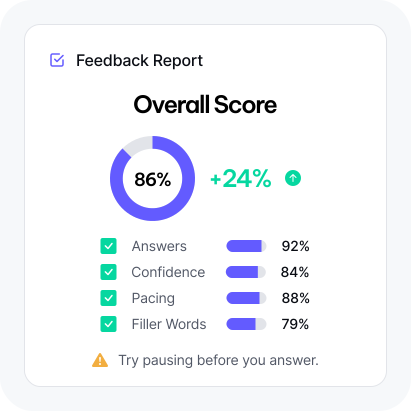
Review feedback on relevance, structure, pace, clarity, filler words, and confidence, but begin with content. Did the answer address the question? Did it show your action? Was the result understandable? A smooth answer without evidence is still weak.
Choose one answer to repeat. Add a missing detail, remove an irrelevant setup, or state the result more directly. Then deliver it again without reading. Compare the two attempts and record the specific change that helped. This turns a scorecard into evidence of progress.
Automated signals should not be treated as an employability verdict. Communication styles, accents, pauses, and disability-related differences require context. Use Resso as a formative coach and seek a career advisor, teacher, or trusted reviewer for consequential interpretation.
Prepare questions that help you evaluate the placement
A co-op or internship is a learning relationship, so your questions matter. Ask what a successful first month looks like, how supervision and feedback work, which projects students usually own, how the team communicates, and what support exists when you do not know something.
Practice asking two questions in the Resso session and responding to the answer. A conversation may create a natural follow-up. This is more realistic than reciting a list at the end. Avoid questions that are answered clearly on the employer's website unless you are asking for deeper context.
The comparison of internships and co-op experiences can help you identify learning, duration, credit, and work expectations worth clarifying before you accept an opportunity.
Simulate the actual interview format
If the interview is remote, practice with the camera, audio, lighting, and sitting position you expect to use. If it is in person, rehearse away from a script and practice entering the answer after a short pause. For a panel, ask the scenario to vary question types and tone.
Complete one end-to-end mock interview close to the expected length. Then review patterns rather than every sentence. Did your strongest example appear too often? Did energy fall late in the session? Did you ask useful questions? Make one or two changes before the final rehearsal.
Prepare practical details separately: route or meeting link, time zone, contact information, clothing, accessibility needs, copies of requested materials, and a backup connection plan. Communication practice works best when logistics are not competing for attention.
A four-session Resso interview plan for students
Session 1: run a diagnostic interview and collect weak question types. Session 2: build your evidence bank and repeat the introduction plus two behavioural questions. Session 3: add tougher follow-ups and practice your questions for the employer.
Session 4: complete a realistic full mock interview, review one content priority and one delivery priority, then stop. You can add a brief warm-up on interview day, but avoid exhausting yourself with another marathon.
After each session, keep one strength, one change, and one next action. That record makes improvement visible even if nervousness fluctuates. Confidence is more reliable when it comes from evidence that you can answer, adjust, and recover.
Frequently asked questions
Can Resso predict the exact interview questions?
No. Use it to practice representative questions, flexible answer structures, listening, and follow-ups rather than trying to predict a script.
What if I have no work experience?
Use truthful examples from coursework, volunteering, clubs, caregiving, sports, creative projects, and community responsibilities that demonstrate relevant behaviour.
Should I paste my resume and job posting into Resso?
Only use documents and details permitted by your institution and the posting. Remove sensitive personal or employer information that is not needed for practice.
How many mock interviews should I complete?
A diagnostic attempt, targeted question practice, and a later full simulation is a strong starting sequence. Add repetitions when they produce a specific improvement.
Can I use AI-generated achievements in my answers?
No. Every claim and example must be truthful. AI can help you organize and rehearse your experience, but it should not invent it.
Arrive with practiced evidence, not memorized promises
Resso can make realistic interview repetition available when a teacher, friend, or career advisor cannot rehearse with you every time. Use that access to test your examples, listen carefully, answer follow-ups, and learn how to recover.
The strongest result is not a perfect score or a scripted personality. It is a student who can explain real experience clearly, ask informed questions, and enter the co-op or internship conversation ready to learn.
.png)