

Why feedback often goes unused
Choose one observable priority for the week
Create a baseline Resso attempt
Turn the priority into a short practice drill
Use scores and analytics as clues, not identities
Track evidence in a simple weekly log
Transfer the skill to a new context
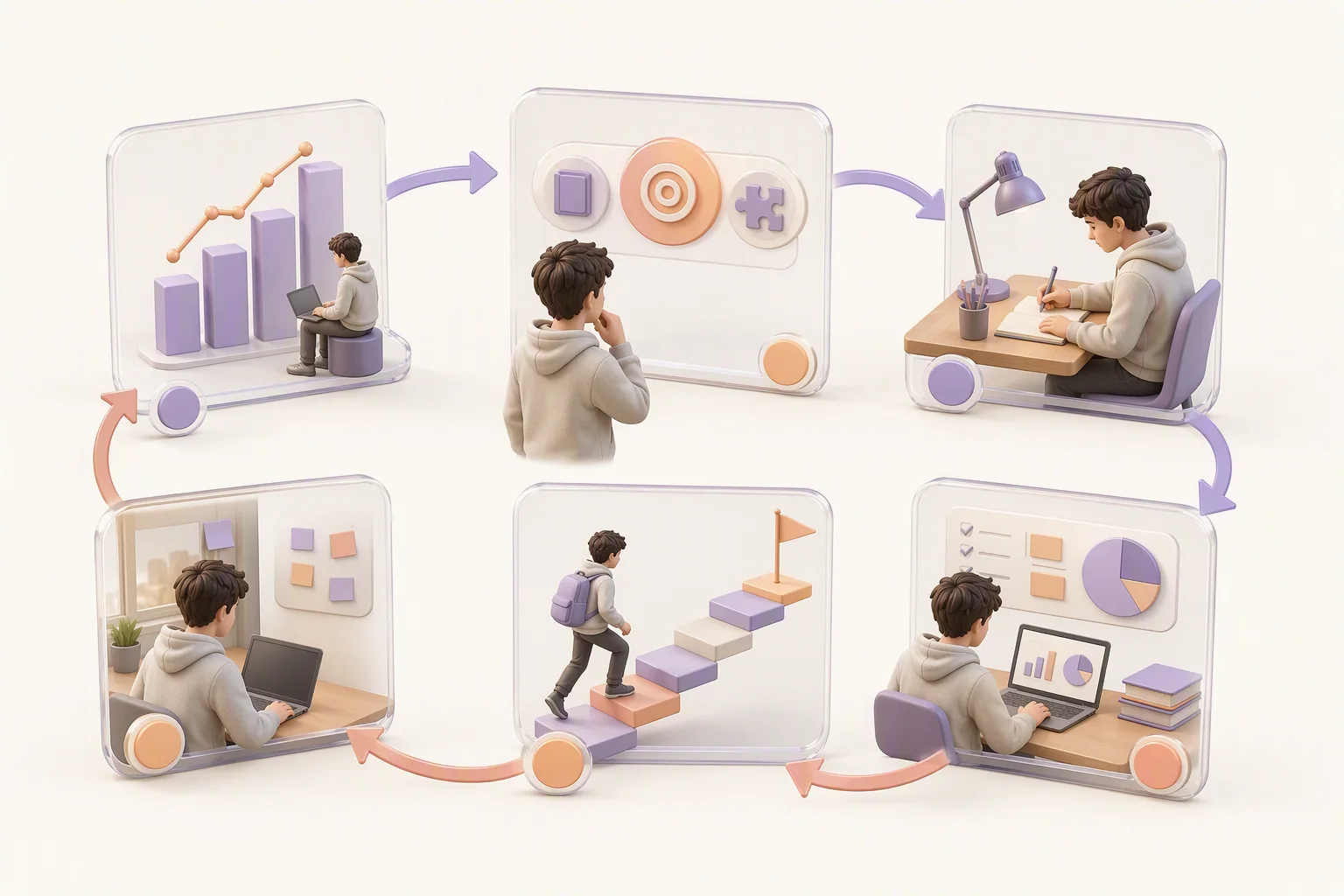
Turn Resso feedback into improvement by choosing one observable priority, repeating a similar scenario with a specific change, and recording evidence across the week. A long scorecard does not create progress by itself. Improvement happens when a student can translate a comment into a behaviour and test that behaviour in another attempt.
This approach works across presentations, interviews, discussions, assignments, and language conversations available through Resso's education practice experience. It also protects you from chasing every number or treating an automated score as a judgment of your intelligence or personality. The plan keeps feedback formative: information for the next attempt.
Why feedback often goes unused
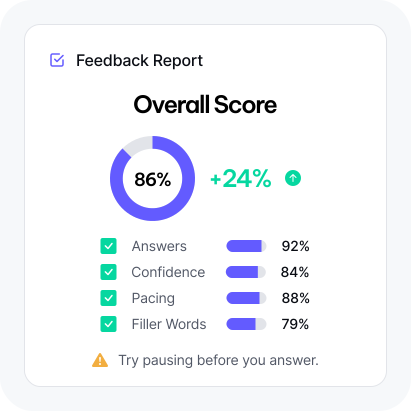
Feedback fails when it is too broad, too late, or too large. “Be more confident” does not describe an action. A report with twenty observations can create attention overload. A score without examples may tell you that something changed without showing what to do next.
Resso can provide immediate feedback after practice, which creates an advantage: the experience is still fresh and you can repeat a short section. The benefit disappears if you close the report, feel good or discouraged about the number, and begin an unrelated scenario next time.
Your first task is interpretation. Ask what audience problem the feedback points to. A late main point may confuse the listener. Long answers may hide evidence. Fast pacing may make a technical explanation hard to follow. That effect suggests a practical change.
Choose one observable priority for the week
Select a behaviour you can hear or see, such as stating the main point in the first two sentences, using one specific example, pausing after a key idea, answering before adding context, or asking one clarification question. Avoid goals based only on a feeling or identity label.
Choose a priority that matters across upcoming situations. If you have a presentation and interview in the same month, concise answer structure may transfer to both. If you are learning a language, successfully repairing a misunderstanding may be more useful than eliminating every filler word.
Write a one-line target and evidence rule: “In three practice answers, I will state the answer before the background, and a listener should be able to repeat my main point.” This turns the goal into something you can test.
Create a baseline Resso attempt
Run one representative scenario without forcing the new behaviour. Save the feedback and write what happened in your own words. Identify one example where the priority affected clarity, relevance, or listener understanding.
Do not treat the baseline as a verdict. It is a starting sample. Performance changes with topic familiarity, fatigue, language, stress, and scenario difficulty. Use a comparable scenario later so the contrast is meaningful.
The article on formative feedback for student speaking explains why a small set of criteria and an immediate next attempt can be more useful than exhaustive scoring.
Turn the priority into a short practice drill
Design a five- to ten-minute Resso scenario that creates several chances to use the behaviour. To practice direct answers, ask for short interview or seminar questions. To practice evidence, ask repeated “What supports that?” follow-ups. To practice clarification, use a scenario with intentionally ambiguous requests.
Keep the content easy enough that the communication behaviour remains visible. If you choose a completely unfamiliar topic, knowledge gaps may hide the skill you are testing. Once the behaviour stabilizes, transfer it to harder content.
Repeat immediately after feedback, but change only the targeted behaviour. You are running a small experiment: same type of task, one meaningful adjustment, and a listener response you can compare.
Use scores and analytics as clues, not identities
A score can summarize selected signals, but it cannot define your worth, intelligence, employability, or readiness on its own. Review what the score measures and whether those criteria match your goal. Some communication qualities are contextual and difficult to reduce to a number.
Look for patterns across attempts rather than reacting to a single change. If the score improves while the answer becomes less accurate or more scripted, the practice has moved in the wrong direction. Content truth and audience purpose remain the anchor.
Accents, disability, culturally different pacing, and individual styles require careful interpretation. Ask a teacher, advisor, or trusted human to review consequential patterns. Automated feedback should support judgment, not replace it.
Track evidence in a simple weekly log
Use five columns: date, scenario, priority, evidence, next adjustment. Evidence can be brief: main point appeared in the first sentence in three of four answers; asked for clarification twice; technical explanation stayed within two minutes; follow-up example became specific.
Also record one strength to preserve. Improvement is not a process of removing everything distinctive from your communication. A vivid example, calm recovery, thoughtful question, or clear analogy can become part of your reliable approach.
Keep the log small enough to maintain. A weekly pattern matters more than detailed notes after one enthusiastic session. If the log shows no change, revise the drill, reduce the difficulty, or seek human feedback on whether you selected the right target.
Add context when it explains a result: unfamiliar subject, noisy room, late session, changed difficulty, or an accessibility adjustment. Context is not an excuse; it helps you compare like with like and prevents a normal fluctuation from becoming a story that you are getting worse.
Transfer the skill to a new context
At the end of the week, test the behaviour in a different Resso category. A clear main point practiced in an assignment explanation can transfer to a job interview. Clarification practiced in language conversation can transfer to group work. Transfer shows that you learned a skill rather than a script.
Then use the behaviour with a person: in class, office hours, a meeting, a peer rehearsal, or a real interview. Notice what changes when another person brings emotion, timing, and social context. Add that evidence to the next plan.
Resso's range of scenario categories makes it possible to test the same communication priority across presentations, discussions, assignments, interviews, and other settings.
Know when to keep practicing, adjust, or move on
Keep the priority for another week when the behaviour appears inconsistently but the drill is still producing useful insight. Adjust the goal when it is too broad, depends on unavailable knowledge, or improves the score while harming natural communication.
Move on when you can use the behaviour in several attempts and at least one new context without constant conscious control. Continue to monitor it lightly while selecting the next meaningful priority.
A practical weekly rhythm is baseline on Monday, short drills on Tuesday and Wednesday, transfer on Thursday, and a realistic test plus reflection on Friday. Rest and real-world schedules may change the days; preserve the learning sequence, not the calendar.
Frequently asked questions
Should I always work on my lowest Resso score?
No. Choose the issue that most affects your current audience and goal. The lowest number may not be the most important or reliable priority.
How many priorities should I practice at once?
One main priority is usually enough for a week. Preserve strengths and note other issues without trying to control every signal simultaneously.
What if my score gets worse after practice?
Check whether the scenario became harder and whether the targeted behaviour improved. One score can fluctuate; compare examples and patterns across similar attempts.
Can I use the same plan for interviews and presentations?
Yes. The scenario changes, but the cycle of baseline, focused change, repetition, evidence, and transfer applies across communication tasks.
When should I ask for human feedback?
Seek it when feedback conflicts with your rubric or experience, when the decision is consequential, or when identity, accessibility, language, and cultural context affect interpretation.
Make feedback earn its place in the next attempt
Resso makes feedback immediate and practice repeatable. The student benefit appears when you choose a small behaviour, change it deliberately, and collect evidence that the listener experience improved.
Use scores as clues, protect the communication strengths that sound like you, and bring human judgment into important decisions. A weekly plan turns feedback from a report you receive into a skill you can use.
.jpeg)