
What is equitable speaking practice?
Why classroom participation can be uneven
What equal opportunity to practice looks like
How private rehearsal changes participation
How to design for disability, language, and anxiety
How technology can widen access without lowering expectations
Equitable speaking practice means every student receives a meaningful opportunity to prepare, speak, receive feedback, and improve. It is not the same as calling on everyone once or requiring identical participation. Students enter a speaking task with different language backgrounds, disabilities, confidence levels, prior experiences, processing needs, and access to support.
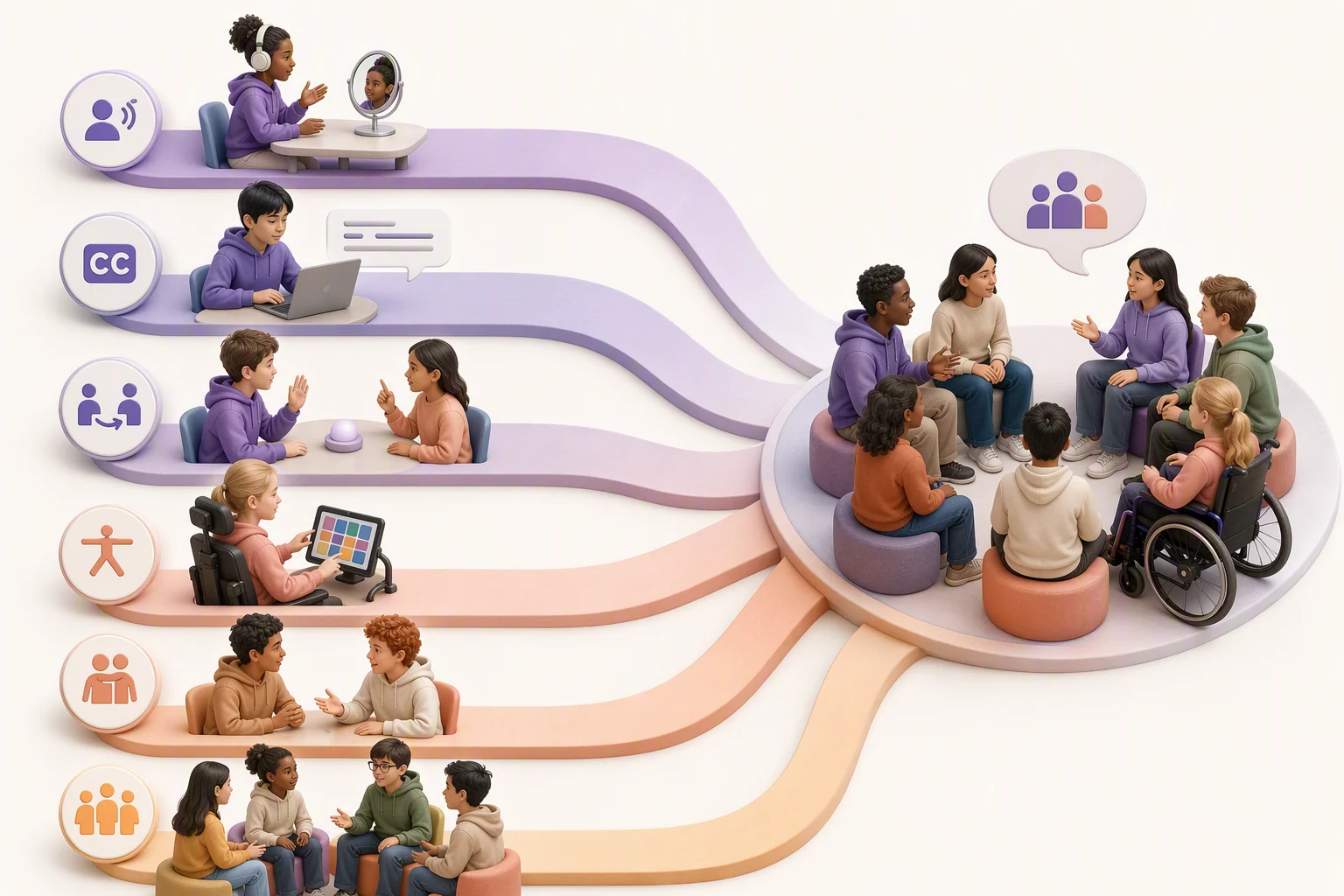
A classroom can maintain high expectations while creating more than one path into practice. Private rehearsal, structured turn-taking, captions, assistive technology, small-group work, and flexible timing can help more students demonstrate what they know. The objective is not easier communication. It is fairer access to the repetitions that build communication.
What is equitable speaking practice?
Equitable speaking practice is the deliberate design of opportunities so that participation and improvement are not limited to students who are already comfortable speaking in public. Every learner works toward a clear communication goal, but the route, support, or mode may vary when those differences preserve the goal.
For example, a class discussion might allow students to rehearse a response privately, contribute in a pair, use a communication device, or prepare a question before joining a larger conversation. A presentation task might include captions, a smaller audience, additional processing time, or a recorded format when appropriate.
Equity focuses on access to the learning process. It asks who gets to practice, who receives useful feedback, whose communication is recognized, and whether the design creates avoidable barriers.
Why classroom participation can be uneven
Whole-class discussion often rewards speed. Students who formulate ideas quickly, feel comfortable interrupting, understand the dominant conversational norms, or have already practiced the language may contribute more often. Their participation creates further practice, while quieter students receive less.
Uneven participation does not prove uneven interest or knowledge. A student may be translating mentally, managing anxiety, using assistive technology, considering the risk of being misunderstood, or waiting for a clear turn. Another may have learned that speaking invites correction or ridicule.
Educators also face practical limits. One teacher cannot hold an individual conversation with every student during each lesson. This is why the structure of practice matters. If speaking opportunities depend only on public volunteers and teacher time, the same students may receive most of the repetitions.
The article on equity and equality offers a useful distinction: giving everyone the same input does not always create comparable access to the outcome. The principle applies in classrooms as well.
What equal opportunity to practice looks like
A fair practice design gives every student an actual turn, not only an invitation. It also gives the learner enough preparation and support to make the turn educational.
Predictable participation: Students know when and how they will contribute, rather than competing for a narrow opening.
Preparation time: Learners can organize a response, review key vocabulary, or choose evidence before speaking.
Multiple repetitions: A first attempt is not the only evidence. Students apply feedback and try again.
Appropriate modes: Voice, captions, text support, communication devices, turn-based conversation, and human assistance can provide access while preserving the communication goal.
Transparent criteria: Students understand what is being practiced and are not evaluated against hidden cultural preferences.
Respectful feedback: Feedback focuses on meaning, clarity, reasoning, listening, and audience needs without treating accent, disability, or personality as a defect.
Equal opportunity does not require every session to look identical. It requires that every learner has a real chance to engage in the skill.
How private rehearsal changes participation
Private rehearsal creates a bridge between understanding and public contribution. Students can hear their own explanation, find missing words, adjust the structure, and experience a complete attempt before attention from others becomes part of the task.
This is especially useful for students who are anxious, new to the language, unfamiliar with the topic, or recovering from a negative speaking experience. It also helps confident students refine substance rather than relying on fluency alone.
Private practice can use a quiet space, a recording, notes, a teacher conference, or a school-approved AI conversation. The method should match the learning purpose and privacy requirements. Students should know whether audio, video, transcripts, or analytics are stored and who can see them.
Private rehearsal should not become permanent isolation. When the goal includes interaction with peers or an audience, practice should gradually connect to that authentic setting. The sequence can move from private response to partner work, small group, and then larger participation.
How to design for disability, language, and anxiety
Disability: Support communication devices, captions, keyboard access, screen readers, alternative input, processing time, and reduced sensory load. Do not assume eye contact, gesture, speed, or vocal volume are universal indicators of engagement.
Language: Provide key vocabulary, model clarification phrases, allow planning, and distinguish language development from subject understanding. An accent is not evidence of weak knowledge.
Anxiety: Reduce avoidable uncertainty, explain the format, separate formative practice from final evaluation, and offer a gradual path into public speaking.
Cultural variation: Explain expectations rather than treating one conversational style as neutral. Directness, pauses, self-promotion, eye behavior, and turn-taking can carry different meanings.
Limited technology access: Provide school devices, in-class practice time, or non-digital alternatives so that improvement does not depend on home equipment or broadband.
The article on why diverse teams perform better emphasizes the value of different perspectives. Equitable communication practice helps those perspectives become available to the group.
How technology can widen access without lowering expectations
Technology can create additional practice capacity. A class of thirty students can rehearse privately or in parallel instead of waiting for one teacher-led turn at a time. Captions, adjustable pacing, turn-based modes, multiple languages, and replay can make the activity more accessible.
However, availability is not the same as equity. Schools should examine device access, interface accessibility, language quality, privacy, bias, and the kinds of communication the tool rewards. A visually impressive avatar is not useful if a student cannot navigate it with assistive technology or if feedback penalizes an accent.
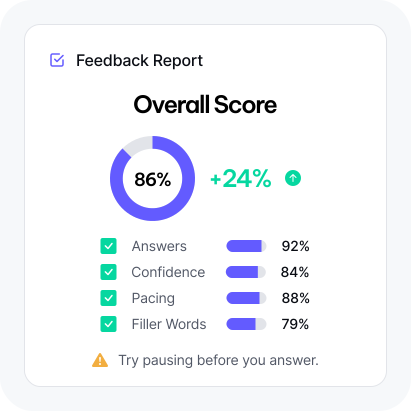
Technology should support educator-defined goals. Teachers choose the scenario, success criteria, and accommodations. Automated feedback can provide a starting point for reflection, but educators remain responsible for interpretation and consequential decisions.
Offer alternatives when the tool is not appropriate for a student or task. Equity improves when technology adds pathways rather than becoming the only path.
How educators can monitor fairness
Look beyond completion. Ask who begins, who repeats, who stops early, whose feedback appears inaccurate, and who needs a different support. Patterns can reveal barriers that individual scores hide.
Participation data: Are all students receiving actual practice opportunities?
Growth evidence: Do multiple attempts show improvement for different groups?
Feedback quality: Are comments specific, understandable, and consistent across accents and communication styles?
Student experience: Do learners feel respected, safe, and able to challenge inaccurate feedback?
Access: Can students use the required modes and supports without additional stigma?
Use these signals to improve the activity, not to label students. The article on culture add instead of narrow culture fit offers a related lesson: systems should not mistake familiarity with one norm for quality.
Frequently asked questions
Does equitable practice mean lowering standards?
No. It means removing barriers that are not part of the learning goal and providing appropriate supports so that more students can work toward meaningful standards.
Should every student be required to speak in front of the whole class?
That depends on the learning outcome. If public presentation is essential, students may need a supported path toward it. If the goal is explanation or discussion, smaller or alternative audiences may provide valid evidence.
How can teachers give every student more speaking time?
Use pairs, small groups, stations, private recordings, structured protocols, or approved conversation technology so students can practice in parallel.
Are captions only for students with hearing disabilities?
No. Captions can also support language learners, students in noisy environments, learners who benefit from written reinforcement, and anyone reviewing unfamiliar vocabulary.
Can automated feedback be biased?
Yes. Schools should test feedback across learners, keep criteria transparent, provide a way to challenge results, and never rely on automated output alone for consequential decisions.
Equity means every student gets a real chance to improve
Speaking ability grows through use, but classroom opportunities are not automatically distributed fairly. Students who already feel comfortable often receive the most practice. Equitable design interrupts that cycle.
Private rehearsal, predictable turns, accessible modes, useful feedback, and multiple attempts can help every learner move toward authentic participation. The standard remains meaningful communication. The difference is that more students receive the conditions needed to reach it.

.jpeg)