Participation is a set of learnable skills
Belonging depends on what happens after practice
Design scenarios around real classroom moments
Teach students how to enter, repair, and exit a conversation
Protect different communication styles
Bridge private practice to authentic classroom participation
Measure participation and belonging separately
Resso can support classroom participation and belonging by letting students rehearse the small conversations that make learning accessible: entering a discussion, asking a question, disagreeing respectfully, requesting clarification, and recovering after a mistake. Participation is not simply a personality trait. It is shaped by safety, preparation, classroom norms, language, prior experience, and whether a learner believes their contribution will be treated with respect.
Belonging cannot be produced by technology, and frequent speaking is not proof that a student feels included. Resso's education practice environment is best used as one part of a broader classroom design in which student ideas matter, multiple forms of participation count, and private rehearsal leads to real opportunities to contribute.
Participation is a set of learnable skills
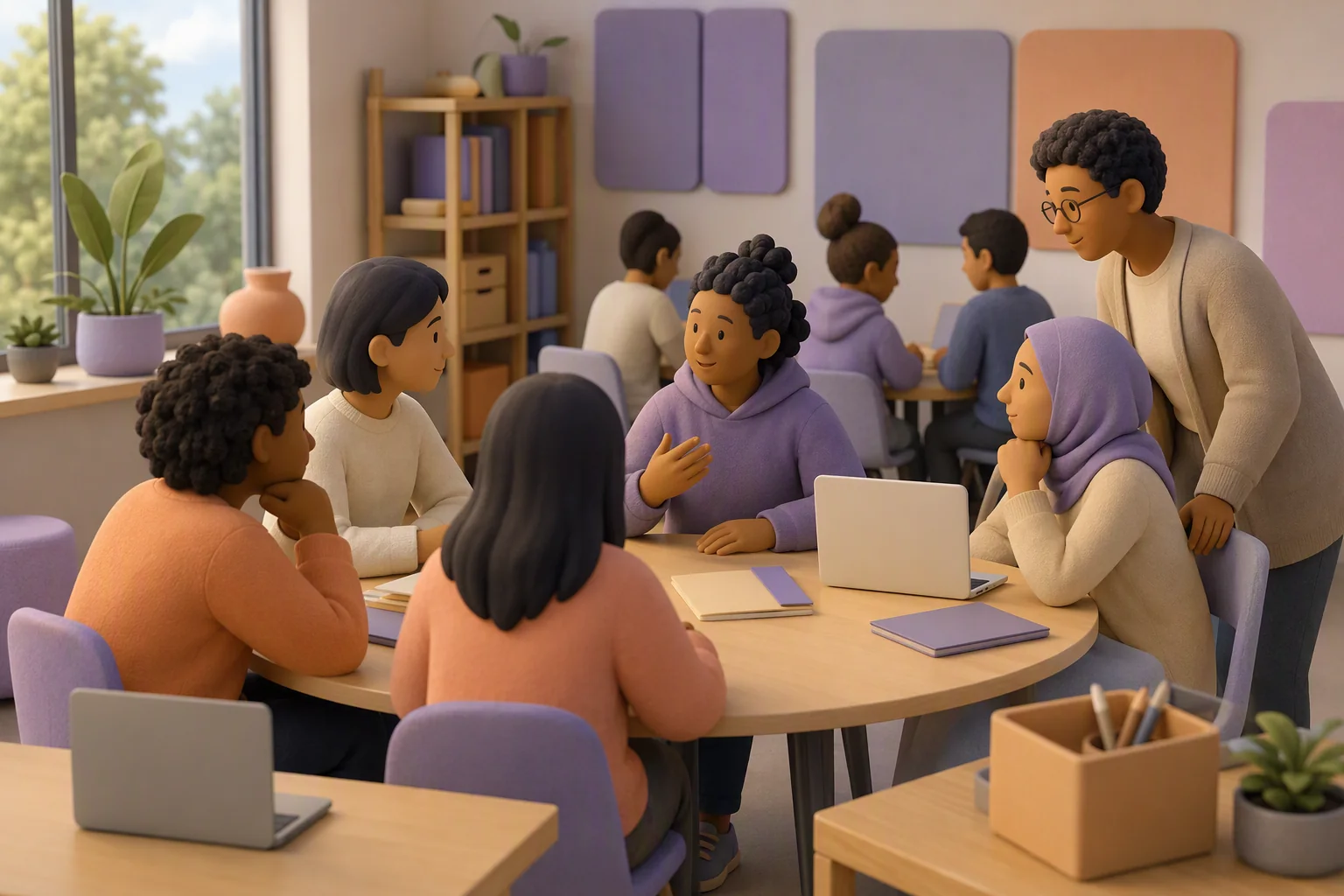
Students are often told to participate without being taught how. Entering a fast discussion requires timing. Asking for help requires identifying the point of confusion. Disagreement requires separating an idea from the person who offered it. These are observable moves that students can notice, practice, and adapt.
A Resso scenario can isolate one move at a time. A learner might practice building on a classmate's idea, asking a follow-up question, or stating a different interpretation with evidence. Because the first attempt is private, the student can experiment with wording before navigating the pace and social complexity of the classroom.
Belonging depends on what happens after practice
Practice helps only if the classroom makes space for the practiced behavior. Teachers need discussion routines that distribute airtime, wait time that supports processing, responses that treat mistakes as part of learning, and alternatives for students who communicate in different ways. Otherwise, rehearsal prepares learners for a door that remains closed.
Use student feedback to examine the environment. Ask whether they know how to enter a discussion, whether their ideas are acknowledged, and what makes participation feel risky. Resso can prepare individual students, while educators use those responses to improve the conditions around them.
Design scenarios around real classroom moments
Choose a current topic and define the discussion purpose. Is the student comparing interpretations, testing a solution, clarifying a misconception, or responding to evidence? Add an audience role and one realistic challenge. A generic 'class discussion' prompt is less useful than a scenario with content, purpose, and a reason to listen.
Resso's Discussion practice experience can introduce follow-up questions and alternate viewpoints. Ask the listener to respond naturally rather than reward a predetermined position. The student should leave better able to explain and revise an idea, not trained to perform agreement.
Teach students how to enter, repair, and exit a conversation
Entry phrases help students connect their contribution to what is already happening: summarize a point, add evidence, ask a clarifying question, or name a connection. Repair phrases help when wording fails: pause, restate the claim, correct a detail, or acknowledge that the idea changed while speaking.
Exiting well is also a skill. A student can finish with a question, identify what remains uncertain, or invite another view. These moves reduce the pressure to produce a perfect final answer. The article on disagreeing without damaging relationships offers language that can be adapted for age-appropriate academic discussion.
Protect different communication styles
Participation should not be measured only by speed, volume, eye contact, or frequency. Multilingual learners, neurodivergent students, anxious students, and reflective thinkers may need additional time or a different route into the conversation. A longer pause can indicate processing, not disengagement.
Configure feedback around the learning goal, such as relevance, evidence, responsiveness, or clarity. Avoid using automated signals to judge attitude, confidence, or belonging. Educators should interpret patterns with the student and honour accommodations, cultural differences, and communication methods that may not fit a narrow speaking template.
Bridge private practice to authentic classroom participation
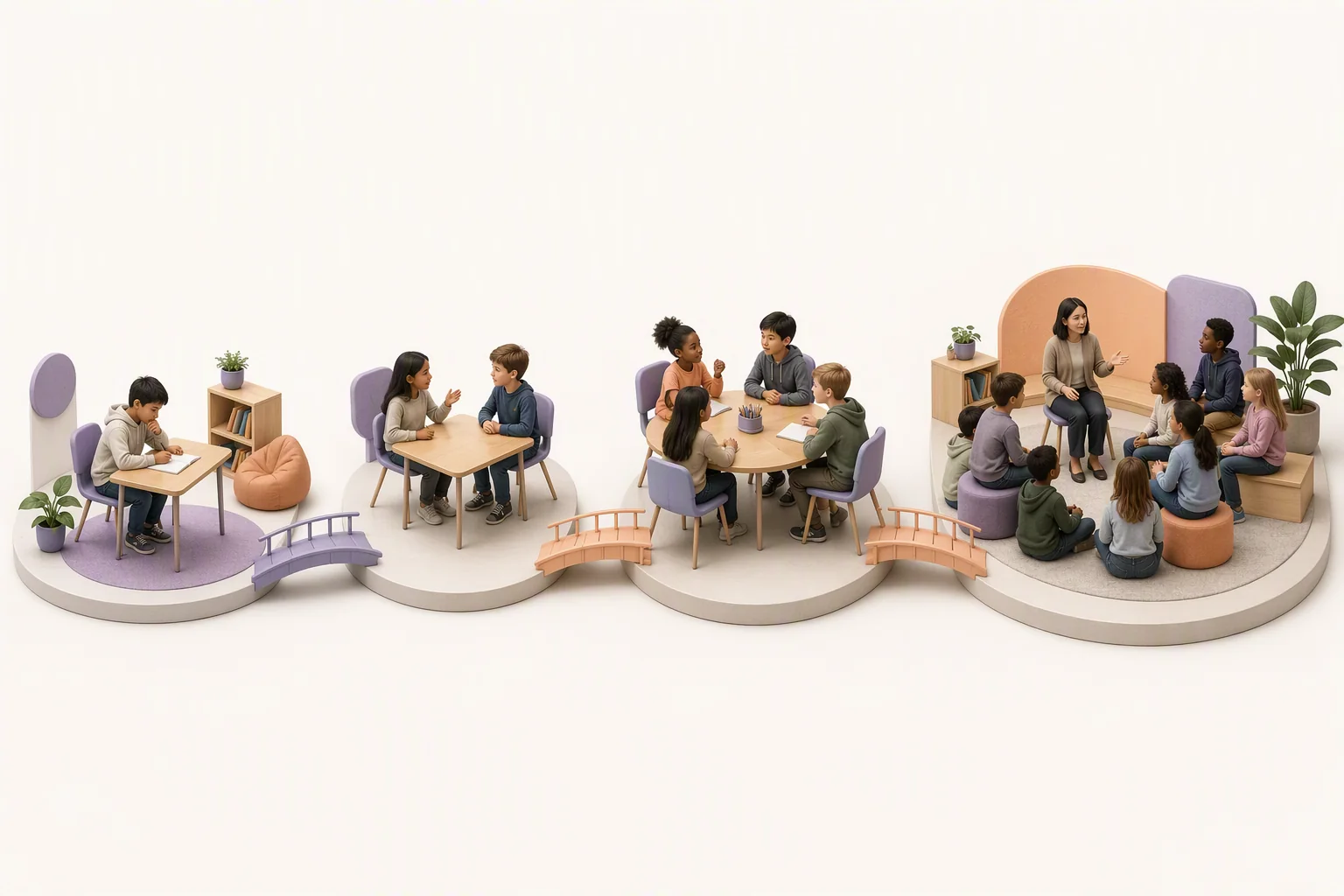
Start with private Resso practice, then move to a partner, small group, and whole-class option when appropriate. The student can carry one prepared question or contribution into the live discussion. This progression preserves the benefit of rehearsal while ensuring the skill is used with real people.
Do not require a public leap from every student on the same day. Some learners may demonstrate readiness in a small group or submit a spoken reflection first. The bridge should be gradual and predictable, with the student able to name what support makes the next step possible.
Measure participation and belonging separately
Practice completion, contribution quality, response to peers, and growth between attempts can describe participation skills. Belonging requires direct student voice, such as whether learners feel respected, known, able to ask for help, and able to make meaningful contributions. One measure cannot stand in for the other.
Look for distribution, not only averages. Did students who rarely spoke gain a usable entry strategy? Did airtime become less concentrated? Did students report lower uncertainty about what to say? These signals can show progress while reminding leaders that belonging remains a relationship and culture outcome, not an automated score.
A four-week Resso implementation sequence
Week 1: define the outcome and collect a baseline. Select one near-term goal: entering a discussion, responding to another idea, and repairing an unclear contribution. Explain the purpose to learners, show the criteria, confirm privacy and accessibility arrangements, and let each participant complete one short attempt before receiving extensive coaching. The baseline is not a grade or a prediction. It gives the learner and educator a concrete starting point and reveals whether the scenario, instructions, device access, and level of challenge are working as intended.
Week 2: teach, practice, and choose one change. Provide the knowledge, examples, vocabulary, or professional framework students need before asking them to perform. Learners then complete a Resso scenario, review feedback, and select one observable improvement that matters to the audience. They repeat only the relevant moment while it is fresh. This focused retry helps students experience cause and effect instead of treating the feedback report as a final judgment about their ability.
Week 3: vary the context and add human interpretation. Change one feature, such as the question, audience, constraint, or level of follow-up, while keeping the core skill stable. Ask the teacher and participating students to review a sample, moderate the criteria, and identify feedback that needs context. Students should explain which suggestion they accepted, which they questioned, and what evidence supports that choice. The purpose is adaptable judgment, not compliance with every automated signal.
Week 4: transfer the skill into an authentic setting. Use a partner, small-group, or whole-class discussion already planned in the curriculum as the next test. Collect only the evidence needed to answer whether practice helped, including better-distributed contributions and student-reported access to meaningful participation. Invite students to describe what transferred and what remained difficult. A real setting may expose timing, relationship, access, or content issues that a simulation could not reproduce, so treat transfer evidence as guidance for the next design cycle rather than a verdict on the learner.
After the pilot, keep the scenario only if it adds value beyond existing instruction. Review participation and outcomes by learner group, document accommodations and missing data, and check that students reached human support when needed. Revise one element at a time, record the reason, and set a future review date. This small, transparent cycle produces a more credible implementation than launching many scenarios without knowing which conditions helped students improve.
Frequently asked questions
Will Resso make every student speak more in class?
Not automatically. It can reduce uncertainty and build specific skills, but teachers must also create fair, safe opportunities for students to use them.
Is frequent speaking the same as belonging?
No. Belonging is better assessed through student experience, relationships, respect, and access to meaningful participation.
Should participation be graded?
If it is assessed, use transparent criteria connected to learning and offer multiple ways to contribute. Avoid grading personality, speed, or eye contact.
Can students practice disagreement with Resso?
Yes. Scenarios can focus on acknowledging another view, presenting evidence, asking questions, and revising a claim without attacking the speaker.
Practice can make participation more reachable
Resso gives students a place to rehearse the moments that often determine whether they enter a learning conversation or remain silent. That preparation can make questions, disagreement, and repair feel less unfamiliar.
Belonging still depends on people. When private practice is paired with inclusive routines, respectful responses, and meaningful classroom roles, more students can experience themselves as legitimate contributors to shared learning.