
What a capstone defense can reveal
Align Resso practice to the capstone rubric
Build a clear project narrative without oversimplifying
Rehearse panel questions that test reasoning
Protect student authorship and academic integrity
Support different learners without reducing rigor
Assess growth and readiness with multiple forms of evidence
Resso can help students prepare for capstone defenses and performance-based assessments by rehearsing the explanation of a problem, process, evidence, decisions, limitations, and next steps before a teacher or panel asks questions. The defense becomes more meaningful when students can do more than present a finished product. They can make their thinking visible.
Practice should strengthen authorship, not manufacture an approved script. Resso's education practice environment gives learners a responsive audience, while educators remain responsible for the rubric, academic integrity, content accuracy, accommodations, and final assessment.
What a capstone defense can reveal
A portfolio or product shows what was completed. A defense can show why the student chose the problem, how they evaluated information, what trade-offs they made, where the work changed, and what they understand now. Questions reveal whether those decisions are connected or merely described after the fact.
The conversation also gives students a chance to acknowledge limits. Strong work is not work without uncertainty. A learner who can explain what the evidence does not show, which constraint shaped the solution, or what they would test next demonstrates judgment that a polished artifact may not display on its own.
Align Resso practice to the capstone rubric
Translate each rubric area into a likely question. If the rubric values inquiry, ask how the question evolved. If it values evidence, ask why one source or method was credible. If it values application, ask how the work responds to a real need. Students should know which criteria guide practice.
Use Resso's Assignment practice experience or a custom scenario to create a panel role with age-appropriate follow-ups. Provide the rubric and a concise project summary when policy allows, but do not upload restricted assessment material, confidential community data, or another student's work.
Build a clear project narrative without oversimplifying
Students need a route through the work: the question or need, the approach, major evidence, key decisions, result, limitation, and next step. This structure helps the audience follow the project without forcing every capstone into the same story.
Ask the student to give a two-minute version before attempting the full defense. Where the explanation becomes vague, identify whether the issue is missing content, unclear organization, or unfamiliar language. Repair the project or reasoning when necessary, not only the delivery.

Rehearse panel questions that test reasoning
A useful panel asks for evidence, alternatives, consequences, and transfer. The digital listener might ask what changed the student's view, why another approach was rejected, how a stakeholder could disagree, or what would happen with more time. These questions should test the stated learning outcomes, not surprise students with unrelated trivia.
Teach learners to pause, answer directly, support the answer, and name a limit. The article on future-ready skills helps connect this ability to explain and defend decisions with later education and work, where knowledge is often evaluated through conversation.
Protect student authorship and academic integrity
Resso should ask students to explain their own work, not generate claims, sources, data, or reflections for them. Educators should state what information can be entered, what assistance is permitted, and how students will disclose AI-supported rehearsal when required.
A defense can strengthen integrity because the learner must connect decisions to evidence and process. However, no conversation is a perfect detector of authorship. Use drafts, process notes, conferences, source checks, and teacher knowledge alongside the defense rather than treating fluency as proof that all work is original.
Support different learners without reducing rigor
Provide question previews, visual organizers, captions, extended response time, alternative input or communication methods, and planned breaks when these support the same learning goal. Students should understand the content and reasoning expected even when the format is adjusted.
Private practice can reduce uncertainty, but it should not become compulsory over-rehearsal. Let students choose shorter sessions and stop when fatigue reduces quality. Educators should also make clear that a polished speaking style is not the same as deeper thinking.
Assess growth and readiness with multiple forms of evidence
Compare the first and later explanation against a small set of criteria: clarity of purpose, connection between evidence and conclusion, response to questions, recognition of limitations, and reflection on learning. Include the capstone artifact and process evidence so the defense remains one source, not the entire grade.
Programs can track completion, rubric growth, student confidence, panel feedback, and the proportion of learners receiving more than one rehearsal opportunity. Those indicators show whether the preparation system is working without claiming that Resso alone caused course completion, graduation, or later employment.
A four-week Resso implementation sequence
Week 1: define the outcome and collect a baseline. Select one near-term goal: explaining the project question, evidence, decision, limitation, and next step. Explain the purpose to learners, show the criteria, confirm privacy and accessibility arrangements, and let each participant complete one short attempt before receiving extensive coaching. The baseline is not a grade or a prediction. It gives the learner and educator a concrete starting point and reveals whether the scenario, instructions, device access, and level of challenge are working as intended.
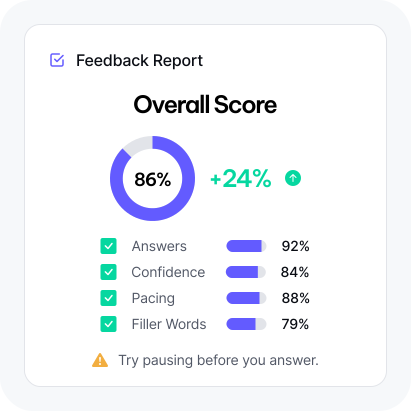
Week 2: teach, practice, and choose one change. Provide the knowledge, examples, vocabulary, or professional framework students need before asking them to perform. Learners then complete a Resso scenario, review feedback, and select one observable improvement that matters to the audience. They repeat only the relevant moment while it is fresh. This focused retry helps students experience cause and effect instead of treating the feedback report as a final judgment about their ability.
Week 3: vary the context and add human interpretation. Change one feature, such as the question, audience, constraint, or level of follow-up, while keeping the core skill stable. Ask the capstone teacher and a moderated panel or peer reviewer to review a sample, moderate the criteria, and identify feedback that needs context. Students should explain which suggestion they accepted, which they questioned, and what evidence supports that choice. The purpose is adaptable judgment, not compliance with every automated signal.
Week 4: transfer the skill into an authentic setting. Use a live capstone defense, exhibition, or performance-based assessment as the next test. Collect only the evidence needed to answer whether practice helped, including stronger reasoning under questions and a clearer connection between process and product. Invite students to describe what transferred and what remained difficult. A real setting may expose timing, relationship, access, or content issues that a simulation could not reproduce, so treat transfer evidence as guidance for the next design cycle rather than a verdict on the learner.
After the pilot, keep the scenario only if it adds value beyond existing instruction. Review participation and outcomes by learner group, document accommodations and missing data, and check that students reached human support when needed. Revise one element at a time, record the reason, and set a future review date. This small, transparent cycle produces a more credible implementation than launching many scenarios without knowing which conditions helped students improve.
Frequently asked questions
Can Resso replace a live capstone panel?
No. It can prepare students through realistic questions and repetition. Human panels provide authentic judgment, relationships, and accountability.
Should students upload their full capstone?
Only when school policy permits and the material contains no restricted, confidential, or personal information. A rubric and concise student-written summary may be enough.
How many rehearsals are useful?
Start with a diagnostic, practice the weakest reasoning or question type, and finish with one realistic defense. Add sessions only when they have a clear purpose.
Does a fluent defense prove the work is original?
No. Use process artifacts, drafts, source checks, teacher observations, and the defense together when evaluating authorship.
A defense should reveal the learning behind the product
Capstone rehearsal helps students move from showing what they made to explaining why it matters and how they know. Resso can make that reasoning visible early enough for the learner to strengthen it.
The strongest defense is not a memorized performance. It is an honest, evidence-based conversation in which the student can explain choices, respond to questions, acknowledge limits, and identify what comes next.
.jpeg)